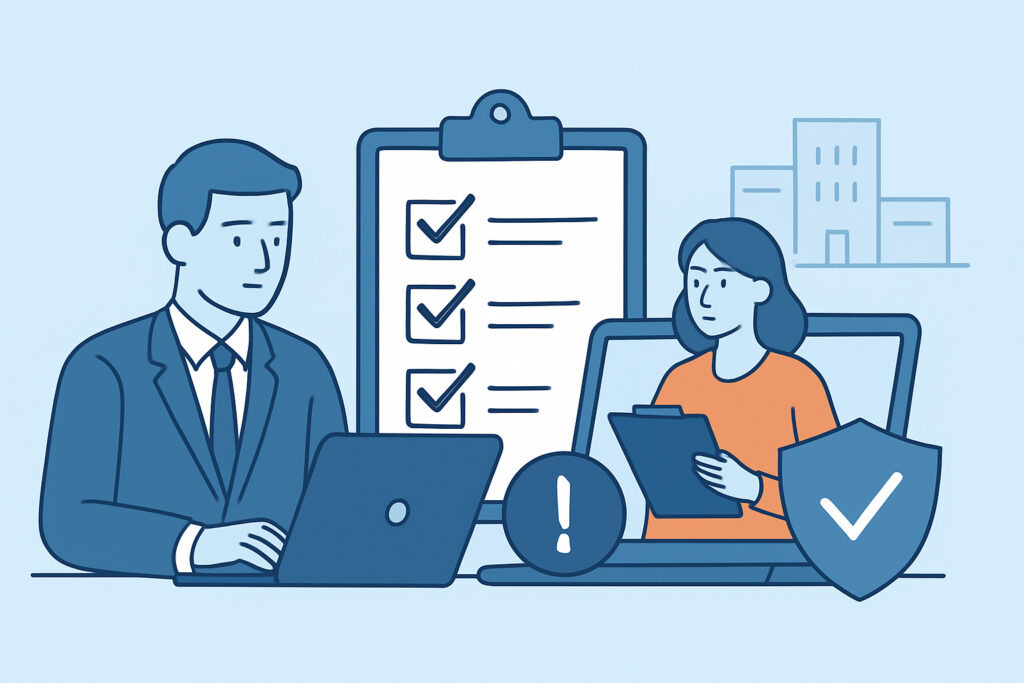
Vendor risk management often gets treated as a procurement checkbox, but for most businesses today it is really a compliance exposure that lives entirely outside their own codebase. Every analytics tag, payment processor, chat widget, and cloud storage provider you connect to your website becomes part of your compliance surface – and regulators increasingly hold the site owner responsible for what those vendors do with visitor data, not just the vendor itself.
This matters because a website’s compliance posture is only as strong as its weakest third-party integration. A privacy policy can be perfectly written, a cookie banner can look flawless, and security headers can be configured correctly – yet a single subprocessor mishandling data, or a script silently phoning home to an undisclosed third party, can undo all of it. Vendor risk management is the discipline of knowing who touches your data, what they do with it, and how you’d prove that to a regulator or a customer who asks.
Why vendor risk extends past your own infrastructure
When a business signs up for a new SaaS tool, embeds a booking widget, or adds a marketing pixel, it is effectively extending its data processing chain to a party it does not control. Under GDPR and similar frameworks, this creates a controller-processor relationship, and the controller (you) remains accountable even when the processor causes the breach or violation.
A common mistake is assuming that a vendor’s own compliance certifications transfer automatically to your site. They don’t. ISO 27001 or SOC 2 status tells you the vendor has internal controls, but it says nothing about whether your specific integration is configured correctly, whether the vendor is listed in your subprocessor disclosures, or whether the data flow matches what your privacy policy actually describes.
Busting the myth that a signed contract equals compliance
One of the most persistent misconceptions is that once a Data Processing Agreement is signed, the vendor risk is “handled.” A DPA is a legal safeguard, not a technical guarantee. It doesn’t stop a script from loading a fourth-party tracker, doesn’t prevent a vendor from changing their data retention practices without notice, and doesn’t verify that the integration on your live site still matches what was agreed on paper.
Contracts establish accountability after something goes wrong; they don’t detect the problem in real time. Businesses that rely solely on signed paperwork often discover the gap only during an audit or after a data subject complaint, by which point the exposure has usually existed for months.
Building a practical vendor inventory
A workable vendor risk process starts with a full inventory, not a partial one built from memory. Marketing teams add tools independently of IT, and the resulting sprawl is often larger than anyone expects.
Steps that tend to work well in practice:
List every script, plugin, embed, and API integration currently live on the site, not just the ones procurement approved. Browser-based scanning tools and network traffic review usually surface more vendors than internal records show.
Classify each vendor by data sensitivity – does it touch personal data, payment data, health information, or nothing identifiable at all. This determines how much scrutiny each one needs.
Confirm a DPA exists for every processor handling personal data, and check that the subprocessor is actually named in your privacy policy’s disclosures, not just referenced generically.
Review data transfer mechanisms for any vendor operating outside your primary jurisdiction, since cross-border transfers often require additional safeguards depending on where the data originates.
Set a recheck cadence – quarterly for high-risk vendors, at minimum annually for lower-risk ones – because vendor terms, subprocessor lists, and integration behavior all change without necessarily notifying you.
Where technical monitoring fits into the process
Vendor risk isn’t static because vendors change their own infrastructure constantly. A payment provider might add a new subprocessor, an analytics tool might update its script to load additional trackers, or a chat widget vendor might quietly change its data retention default. None of these changes require your approval, and none of them show up unless someone is watching for them.
This is where technical monitoring becomes the practical complement to contractual controls. Watching for unexpected third-party script behavior, unauthorized data calls, and mismatches between disclosed subprocessors and actual network activity catches the gap between “what the contract says” and “what the site is actually doing.” Third-party scripts are a particularly common source of hidden data leaks, since a single tag manager update can introduce a new vendor relationship without anyone reviewing it from a compliance angle.
Documenting vendor decisions for accountability
Regulators and auditors don’t just want to see that a risk was managed – they want to see the reasoning behind each decision. Why was a particular vendor approved, what data does it access, what alternative was considered, and who signed off. Teams that keep this documentation current spend far less time scrambling during an actual audit or investigation, because the paper trail already exists.
This is also where subprocessor disclosures deserve special attention. A privacy policy’s subprocessor list is often the first thing regulators check against actual data flows, and a stale or incomplete list is one of the easiest gaps to find during a review.
Frequently asked questions
Does vendor risk management apply to small businesses with only a few third-party tools?
Yes. Even a single payment processor and one analytics tool create a data processing chain that needs documentation. Scale changes the volume of work, not whether the obligation exists.
How often should Data Processing Agreements be reviewed?
At minimum annually, and immediately whenever a vendor changes its terms, subprocessors, or the scope of data it handles. Not every vendor relationship requires a DPA, so it’s worth confirming which integrations actually trigger the requirement before assuming blanket coverage is needed.
What’s the biggest blind spot businesses have with vendor risk?
Marketing and product teams adding new tools without looping in whoever owns compliance. The technical integration happens in minutes; the compliance review, if it happens at all, often happens months later or not at all.
Vendor risk management works best as a continuous habit rather than an annual project. Build the inventory, confirm the paperwork matches reality, and keep watching for the small technical changes that quietly turn a compliant integration into an unmonitored liability.