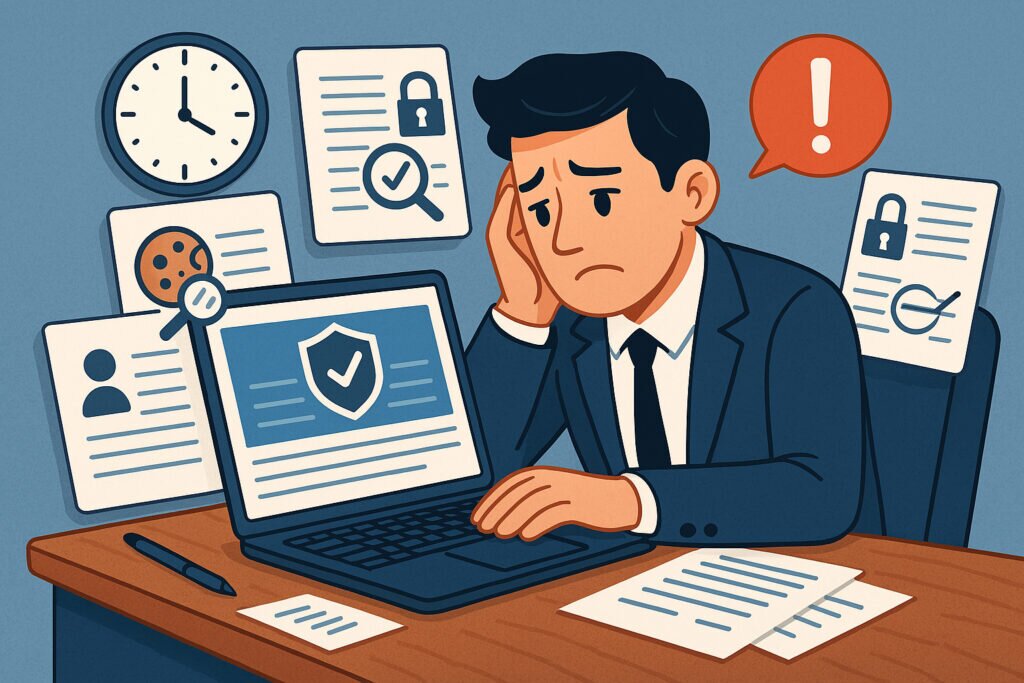
When you’re running a website or managing digital properties for clients, the hidden costs of manual compliance checking can quietly drain your budget, your time, and your peace of mind. Most business owners assume they can handle compliance themselves — a quick monthly click-through of the privacy policy page, a glance at the cookie banner. After all, how hard can it be? This mindset, which I’ve seen countless times working with web services of all sizes, leads to surprisingly expensive consequences that nobody sees coming until it’s too late.
The Time Drain Nobody Accounts For
Let’s start with the most obvious cost: your time. A thorough manual compliance check isn’t a five-minute job. You need to verify that your privacy policy is accessible, check that cookie consent banners are functioning properly — not just visually but technically — confirm your terms of service are displaying correctly, and ensure all legally required information like business registration numbers is visible. Then there’s SSL certificate validation, security headers, accessibility statements, and consumer rights disclosures.
If you’re doing this properly, you’re looking at 30–45 minutes per website, per check. For a single site checked weekly, that’s roughly 30 hours per year. If you’re a web agency managing 20 client sites, we’re talking about 600 hours annually — nearly four months of full-time work just on compliance checking. At even a modest hourly rate of $75, that’s $45,000 in labor costs that could be spent on revenue-generating activities.
The False Sense of Security
Here’s something I learned the hard way: manual checking creates dangerous blind spots. You check your site on Monday, everything looks perfect. On Wednesday, a plugin update breaks your cookie consent system. On Thursday, a developer accidentally removes the privacy policy link from the footer. You don’t discover any of this until your next scheduled check — and in the meantime, you’ve been collecting user data without proper consent mechanisms in place.
The problem isn’t that you’re not checking — it’s that you’re not checking constantly. Websites change daily through content updates, plugin modifications, theme adjustments, and server configurations. A snapshot check once a week or once a month only tells you about that specific moment, not the other 167 hours when problems might arise. This is exactly why real-time compliance monitoring exists — to close the gap between checks.
Busting the “Good Enough” Myth
One of the most persistent misconceptions I encounter is the belief that if a compliance element looks correct on screen, it must be working correctly. This is flat-out wrong. A cookie consent banner can render beautifully while failing to block tracking scripts before consent is given. A privacy policy page can load fine for you but return a 404 for visitors in certain regions or on certain devices. An SSL certificate can show a padlock in your browser while missing critical security headers that regulators actually check.
Visual inspection catches cosmetic issues. It does not catch functional failures. And regulators don’t care whether your banner looked nice — they care whether it actually prevented non-consented data collection. This gap between appearance and technical reality is where most compliance violations hide, and it’s a gap that manual checking simply cannot close.
The Actual Financial Risks
GDPR fines can reach up to 4% of annual global turnover or €20 million, whichever is higher. Even minimum fines for data protection violations in many EU countries start at €10,000–€50,000. In the US, California’s CCPA allows for statutory damages of up to $750 per consumer per incident.
But here’s the part that really stings: most businesses don’t get fined for deliberately ignoring compliance. They get fined for technical failures they didn’t know about. A broken cookie consent banner after a CMS update. An inaccessible privacy policy after a site redesign. An expired SSL certificate that you would have renewed if only you’d noticed it was about to lapse.
The Opportunity Cost of Worry
There’s a psychological burden to manual compliance checking that rarely gets discussed. Every time you publish content, update your site, or install a plugin, there’s this nagging question: “Did this break something compliance-related?” This constant low-level anxiety consumes mental energy that should be focused on growing your business.
I’ve watched business owners delay necessary website improvements because they were worried about compliance implications. They stick with outdated themes, avoid beneficial plugins, and hold their digital presence back — all because managing compliance manually has become such a source of stress that they’d rather not make changes at all.
When Manual Checking Fails Completely
Manual checking doesn’t scale. If you operate multiple websites or subdomains — which is increasingly common — the task becomes genuinely impossible to manage without errors. You might remember to check your main site, but what about that promotional landing page from six months ago? Or the subdomain running your documentation?
Companies with excellent intentions fail here all the time. They create elaborate spreadsheets, set calendar reminders, and assign responsibilities. Then someone goes on vacation, gets buried in a project, or simply forgets. One missed check, one overlooked warning, and suddenly you’re dealing with a data protection authority inquiry.
The Documentation Problem
Regulators don’t just want compliance — they want proof of compliance. When you’re checking manually, how do you document what you’ve verified and when? Screenshots? Spreadsheet entries? Written logs? All of these take additional time, and none provide the systematic, timestamped evidence trail that automated compliance monitoring generates effortlessly.
Without proper documentation, even a fully compliant website can struggle during a regulatory inquiry. You might have been compliant every single day, but if you can’t prove it, regulators have no reason to take your word for it.
Frequently Asked Questions
How much time does manual compliance checking actually take per website?
A proper manual check covering privacy policies, cookie consent functionality, terms of service, business ID visibility, SSL certificates, security headers, and accessibility statements takes 30–45 minutes per site. For weekly checks, that adds up to roughly 30 hours per year per website — time that grows linearly with every additional site or subdomain you manage.
Can’t I just use a checklist and check once a month?
Monthly checks leave 29 days of unmonitored exposure between each review. Websites change constantly through updates, deployments, and third-party script changes. A compliance failure that occurs on day two and isn’t caught until day thirty means nearly a full month of potential regulatory risk — and potential data collection without proper consent.
What’s the biggest risk of sticking with manual compliance checks?
The biggest risk is the gap between what you see and what’s actually happening. Manual checks capture a single moment in time and rely on visual inspection, which misses technical failures like improperly configured cookie scripts or security header weaknesses. Most compliance fines stem from exactly these kinds of invisible, ongoing issues that only continuous automated monitoring can reliably detect.
The Real Question
The hidden costs of manual compliance checking add up fast: wasted hours, constant anxiety, real financial exposure, and missed business opportunities. The question isn’t whether you can afford to automate website compliance monitoring. The question is whether you can afford not to.
Your time has value. Your peace of mind has value. And your business’s protection from preventable compliance failures definitely has value. When you tally up all the hidden costs, manual checking isn’t the budget-friendly option it appears to be — it’s actually one of the most expensive approaches you can take.