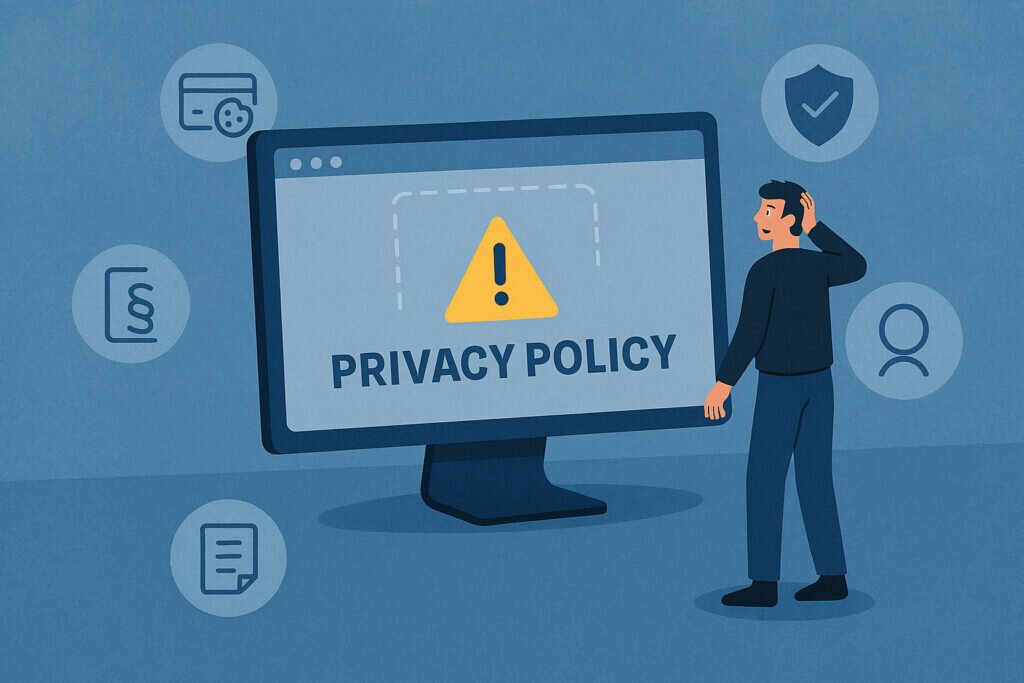
If your privacy policy suddenly disappears from your website, you could be facing legal violations, broken consent mechanisms, and eroded customer trust – all without realizing it. A missing privacy policy page is one of the most common yet underestimated compliance failures, and it often goes undetected for days or weeks. Here’s what actually happens when that critical page vanishes, and what you need to do about it.
How a Privacy Policy Disappears in the First Place
Nobody deletes their privacy policy on purpose. In my experience, it’s almost always a chain of small technical events that snowball. A server migration that missed a redirect. A CMS update that broke the page template. An eager developer who “cleaned up” what looked like outdated legal pages during routine maintenance.
The real danger is the ripple effect. Your privacy policy link isn’t in just one place – it’s in your site footer, registration forms, email templates, and cookie consent banners. One broken URL instantly creates a compliance gap across your entire digital presence. And because it’s a single page rather than a full site outage, it slips right past most basic monitoring setups.
Legal Compliance Collapses Immediately
Under GDPR, you must inform users about data collection and processing before it happens. The moment your privacy policy page goes dark, every form submission, newsletter signup, and account registration on your site occurs without proper disclosure. That’s not a grey area – it’s a regulation violation that can attract fines and formal investigations.
The same logic applies under CCPA, PIPEDA, and dozens of sector-specific rules worldwide. Your privacy policy is the legal backbone of every data processing activity on your site. Without it, you’re effectively operating in a compliance vacuum where your privacy disclosures are technically inaccessible.
Your Cookie Consent Banner Breaks Too
Here’s a myth worth busting: many site owners believe that as long as their cookie consent banner appears on screen, they’re covered. They’re not. Most consent banners link directly to the privacy policy for detailed information about tracking technologies and data usage. When that link leads to a 404 page, the entire consent mechanism becomes legally questionable.
Users are supposed to make an informed choice. A banner that links to a dead page doesn’t provide informed consent – it provides the illusion of it. I’ve seen e-commerce businesses discover their privacy policy had been down for weeks while thousands of users clicked “Accept” on a banner pointing nowhere. Retroactively dealing with that data is a legal headache nobody wants. Understanding the difference between technical and visual cookie consent compliance is critical here.
Customer Trust Erodes Faster Than You Think
Beyond the legal mechanics, there’s the human reaction. When a privacy-conscious visitor clicks your policy link and hits an error page, the message is clear: you don’t take data protection seriously. In an era where breach headlines are a weekly occurrence, that broken link plants doubt. Are passwords stored securely? Is payment data protected? One missing page makes people question everything.
This also affects business partnerships. Payment processors like Stripe, advertising platforms like Google Ads, and enterprise clients run compliance checks. A missing privacy policy can halt onboarding, delay launches, and stall deals. I’ve seen partnership agreements fall apart over exactly this kind of issue during routine due diligence.
Why You Won’t Notice It Without Monitoring
The scariest part of a disappearing privacy policy is the detection gap. Unlike a full site outage that triggers alarms everywhere, a single missing page can hide for weeks. Your homepage loads fine. Your checkout works. Nobody checks the privacy policy link on a Tuesday afternoon.
Basic uptime monitoring isn’t enough either. The page might return a 200 status code but display completely wrong content after a migration. Or it might redirect to a generic 404 template that technically “loads” but contains none of your actual policy text. You need monitoring that verifies both availability and content integrity – and detection speed matters enormously when every hour of downtime expands your compliance exposure.
How to Recover When It Happens
If you discover your privacy policy is missing, move fast. Restore the page immediately from your backup system or version control. If those fail, check the Internet Archive’s Wayback Machine or Google’s cached version.
Then document everything. Note when the page likely went missing and for how long. This timeline is crucial if you ever need to demonstrate due diligence to a regulator. If the downtime was significant – more than a few days – consider notifying your users about the gap, especially if data was actively collected during that period.
Finally, put prevention in place. Assign clear ownership of compliance page integrity to a specific person or role. Don’t let it be everyone’s responsibility, because that means it’s nobody’s. Create a post-deployment checklist that includes verifying legal page accessibility after every site change. And implement continuous monitoring that checks critical pages multiple times per day – this is exactly why legal documents need around-the-clock availability monitoring.
Frequently Asked Questions
Can I use a generic privacy policy template while restoring my original?
Something is better than nothing, but be cautious. A generic template probably doesn’t accurately describe your actual data practices, which creates a different compliance problem – misleading disclosures. It’s better to prioritize restoring your original policy quickly rather than substituting a placeholder that might not reflect reality.
Do I need to notify regulators if my privacy policy was temporarily down?
It depends on jurisdiction and circumstances. If no data breach occurred and the downtime was brief, voluntary reporting typically isn’t required. However, if you receive a complaint during the period or the outage lasted more than a few days, disclosure may become necessary. Always document the incident regardless.
How often should I check that my privacy policy page is accessible?
Manual monthly checks are dangerously inadequate. Automated monitoring that runs multiple times per day is the minimum standard for any business that collects user data. The gap between a page going down and your team noticing it is where compliance risk lives – shrink that gap as much as possible.
Don’t Wait for the Wake-Up Call
Websites are complex systems with many moving parts. Updates, migrations, and routine changes can break things in unexpected ways. Your privacy policy is too important to leave to manual spot checks and hope. Continuous automated monitoring catches the problem in minutes instead of weeks – and that difference can mean the difference between a quick fix and a regulatory inquiry. In compliance, what you don’t know absolutely can hurt you.