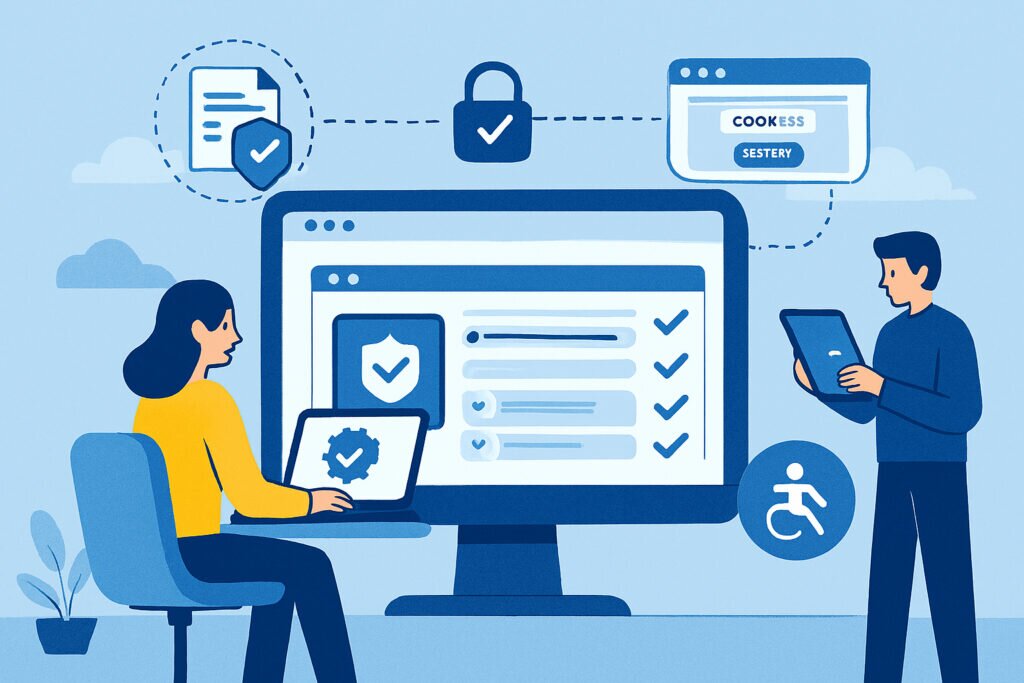
Automated compliance monitoring is the practice of using technology to continuously check whether a website meets its legal, technical, and regulatory obligations – and for most businesses today, it’s rapidly replacing the old model of scheduling periodic manual audits. This article explains why that shift is happening, what manual audits genuinely miss, and how automated compliance works in practice so you can make an informed decision about your own approach.
Running a website in 2025 means staying on top of GDPR requirements, cookie consent rules, SSL certificate validity, security headers, accessibility statements, consumer rights notices, and more. Doing all of that manually, even quarterly, is increasingly unrealistic for teams without dedicated compliance staff.
What Manual Compliance Audits Actually Look Like
Manual audits typically involve a compliance officer or external consultant working through a checklist at a fixed interval – monthly, quarterly, or annually. They’ll visit the website, check whether a privacy policy is linked, verify cookie banners appear, and perhaps run a quick SSL check.
The problem isn’t that these checks are wrong. It’s that they capture a snapshot in time, not the ongoing reality. A website is a living system. Content gets updated, plugins are patched, CMS deployments overwrite configuration files, and third-party scripts change behavior without any notice to the business owner.
Between audit dates, the site operates in an unchecked state. That’s where most compliance failures occur – not during the audit window, but in the weeks or months before the next one is scheduled.
The Gap Between Appearance and Technical Reality
One of the most persistent misconceptions in website compliance is that if something looks right, it is right. A cookie consent banner that appears on screen seems compliant – but the actual test is whether it blocks non-essential cookies before consent is given. Many banners fail this technically while appearing perfectly functional to the human eye.
The same applies to privacy policies. A page might load fine during an audit but return a 404 error two weeks later after a URL restructure. A terms of service document might be present but require a login to access, which fails basic availability requirements.
Manual auditors checking boxes during a scheduled visit have no realistic way to catch these issues unless they happen to occur during the audit itself. Automated systems, by contrast, check continuously – and detect a broken link or missing header within minutes of it happening.
For a deeper look at where these gaps appear, Website Compliance Gaps That Only Automation Can Find is worth reading before your next audit cycle.
What Automated Compliance Monitoring Covers
Effective automated compliance monitoring isn’t a single tool that checks one thing. It operates across multiple layers simultaneously:
Legal document availability: Continuous verification that your privacy policy, terms of service, and other required documents are publicly accessible without barriers – not just present in a navigation menu.
Cookie consent behavior: Technical checks that the consent mechanism actually functions as required, not merely that a banner appears visually.
SSL certificate status: Monitoring for certificate validity, expiration warnings, and configuration issues – with advance alerts before expiration causes compliance or trust problems.
Security headers: Automated analysis of HTTP response headers to identify missing or misconfigured headers that regulators and data protection authorities increasingly expect to see.
Business registration details: Verification that legally required business identification – company registration numbers, VAT IDs, registered addresses – remains visible on the site as required under EU and national regulations.
Accessibility statement presence: Confirmation that an accessibility statement is available and discoverable, which is a legal requirement for many public and commercial websites across the EU.
A Realistic Scenario: The Update That Breaks Compliance
Consider a mid-sized e-commerce business operating under GDPR. Their compliance audit in January confirmed everything was in order. In March, the development team pushed a CMS update that inadvertently changed the URL structure for legal pages. The privacy policy URL returned a 404 for eleven days before a customer noticed and flagged it.
During those eleven days, every user who visited the site encountered a broken privacy policy link. Under GDPR, that’s a transparency failure. Under consumer protection rules in several EU member states, it may also constitute a failure to display required information.
An automated system would have detected the 404 within minutes and triggered an alert with the specific URL and remediation steps. The manual audit scheduled for June would have caught nothing – the issue would have been resolved or, worse, ongoing without anyone knowing.
This pattern is not unusual. Why One-Time Compliance Audits Are No Longer Enough breaks down exactly why the audit-then-wait cycle is structurally unsuitable for modern websites.
Time and Resource Reality for Compliance Teams
Manual compliance work takes time that most internal teams don’t have. A thorough manual check of a medium-complexity website – covering legal documents, cookie behavior, security headers, SSL, accessibility, and business ID display – realistically takes several hours per review cycle, assuming the person doing it has the technical knowledge to check beyond surface-level appearance.
Outsourcing to consultants adds cost and still doesn’t solve the continuity problem. A consultant’s report is accurate for the day it was written.
Automation shifts the resource equation. Instead of allocating staff hours to periodic checks, teams receive alerts only when something requires attention. The monitoring runs continuously in the background, and human effort is reserved for remediation rather than discovery.
For businesses weighing this decision, the Automated vs. Manual Compliance: Time and Cost Analysis provides concrete numbers on where time and money actually go under each approach.
Common Myth: Automation Replaces Compliance Expertise
A frequent objection to automated compliance tools is that they remove human judgment from the process. This misunderstands what automation does.
Automated monitoring handles detection and alerting – the parts of compliance work that require consistency, speed, and continuity. It does not interpret regulatory nuance, draft policy language, or advise on jurisdiction-specific legal requirements. Those tasks still require qualified people.
What automation removes is the tedious, repetitive, error-prone work of manually checking dozens of compliance signals on a schedule. The compliance expertise is still needed – it’s just applied to decisions and remediation rather than spent on discovery tasks that technology does better.
Frequently Asked Questions
How often does automated compliance monitoring check a website?
Effective automated systems run checks continuously or at very frequent intervals – typically every few minutes to hours depending on the signal being monitored. SSL certificate checks, legal document availability, and cookie consent behavior are among the checks that should run frequently enough to detect failures before customers encounter them.
Does automated compliance monitoring work for small websites?
Yes, and arguably it’s more important for small sites than large ones. Larger businesses often have dedicated legal and IT teams who can catch issues quickly. Smaller operators typically don’t have that coverage, which means issues can go undetected far longer. Automation provides the same monitoring capability regardless of team size.
Can automated tools detect all compliance issues?
No tool detects everything. Automated compliance monitoring excels at identifying technical and availability issues – broken links, missing headers, expired certificates, non-functional cookie consent mechanisms, missing business ID display. It does not replace legal review of policy content, jurisdiction-specific regulatory interpretation, or accessibility testing that requires user interaction. The value is in the continuous layer of protection it provides for the signals it does monitor.
Making the Practical Decision
The case for automated compliance as a smart alternative to manual audits comes down to one practical reality: websites change continuously, and compliance must be checked continuously to match.
Manual audits remain useful for periodic deep reviews, legal document updates, and regulatory interpretation. But as the primary method for catching compliance failures, they’re structurally unable to keep up with how websites actually operate.
The strongest approach combines both: automated monitoring running continuously in the background, with periodic expert review to assess whether policies and legal documents remain adequate. Neither replaces the other entirely – but without the continuous layer, compliance gaps accumulate silently between audits, and the cost of discovering them after the fact is almost always higher than the cost of catching them in real time.