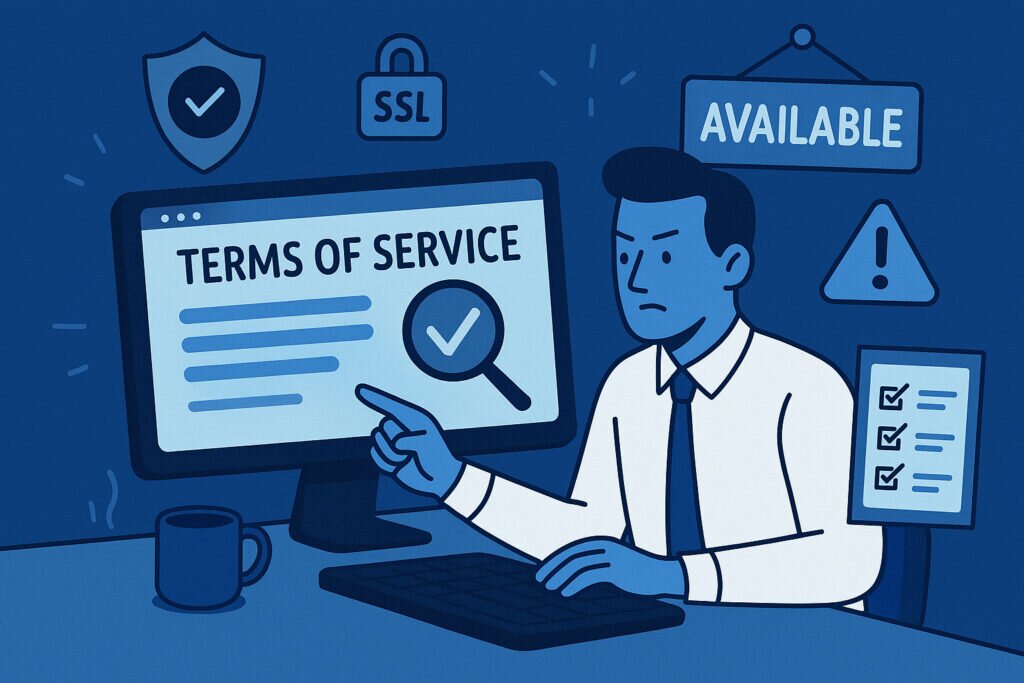
Most website owners treat their Terms of Service like a fire extinguisher – they install it once and forget it exists until something goes wrong. But here’s the uncomfortable truth: if your Terms of Service document isn’t accessible when a dispute arises, you might as well not have one at all. I learned this the hard way when a client faced a payment dispute, only to discover their ToS page had been returning a 404 error for three weeks after a routine site update. The legal protection they thought they had simply vanished.
The Legal Foundation of Availability
Terms of Service documents serve as binding contracts between you and your users, but contract law has a fundamental requirement: both parties must have reasonable access to the terms they’re agreeing to. Courts across multiple jurisdictions have consistently ruled that unavailable or inaccessible terms cannot be enforced. This isn’t just a technicality – it’s the bedrock principle of contractual consent.
When your ToS page goes down, even temporarily, you’re creating a legal blind spot. Any user interaction during that downtime occurs without a valid contractual framework. If a dispute emerges from that period, you’ve lost your primary defense mechanism. The legal exposure isn’t theoretical; it’s immediate and measurable.
Common Causes of ToS Unavailability
Website changes are the silent killer of ToS accessibility. I’ve monitored hundreds of sites over the years, and the pattern repeats endlessly: a redesign launches, internal links get restructured, and suddenly the ToS link in the footer points to nowhere. The legal team assumed the development team would preserve all legal pages, while the developers assumed anything not in the content migration checklist wasn’t critical.
Plugin conflicts create another vulnerability, especially on platforms like WordPress where themes and plugins interact in unpredictable ways. A caching plugin update might exclude certain pages, or a security plugin could mistakenly flag your ToS as suspicious content. Server migrations are equally treacherous – I’ve seen cases where .htaccess rules or nginx configurations inadvertently blocked access to legal documents.
The 24/7 Compliance Requirement
Unlike most website content, your Terms of Service must maintain perfect uptime. A product page being down loses you sales; a ToS page being down loses you legal protection. This creates an asymmetric risk profile that most monitoring solutions ignore because they focus on user-facing content and conversion paths.
The problem compounds internationally. If you serve European customers, GDPR requires that your terms are “freely given, specific, informed and unambiguous.” An unavailable ToS fails the “informed” test automatically. For e-commerce sites handling transactions across time zones, there’s literally no safe window for downtime. Your ToS must be available when a customer in Tokyo makes a purchase at 3 AM your local time, or when someone in Berlin shops during your maintenance window.
What Courts Actually Look For
Legal precedents show that courts examine several factors when determining if Terms of Service were properly presented. Accessibility ranks at the top. The document must load reliably, display correctly across devices, and remain accessible without requiring special authentication or navigation knowledge. I’ve reviewed cases where companies lost enforceability arguments simply because their ToS required three clicks through unmarked pages to reach.
Timestamp evidence matters enormously. If you can’t prove your ToS was accessible at the exact moment of the disputed interaction, you’re arguing from weakness. This is why automated monitoring provides more than operational benefits – it creates a timestamped audit trail demonstrating continuous availability. That documentation becomes crucial evidence in legal proceedings.
The Hidden Cost of Manual Checking
Some businesses assign staff to manually check their legal pages weekly or monthly. This approach fails on multiple levels. First, it’s reactive rather than preventive – by the time someone notices the ToS is down, damage has already occurred. Second, humans miss things during routine checks, especially technical issues like SSL certificate problems or JavaScript errors that prevent proper rendering.
More critically, manual checking can’t provide the continuous documentation that legal situations demand. Saying “we check it every Monday” doesn’t prove the page was accessible on Thursday when the disputed transaction occurred. The evidentiary gap creates reasonable doubt that courts won’t ignore.
Beyond Just Uptime
Monitoring Terms of Service availability means more than checking if the page returns a 200 status code. The content must render correctly across browsers and devices. I’ve encountered situations where ToS pages loaded fine on desktop but JavaScript errors prevented mobile display – and mobile represented 70% of that site’s traffic. The legal exposure was proportional to the user base affected.
Version control becomes essential too. When you update your terms, you need documentation proving when the new version became available and how users were notified. Monitoring systems should track content changes alongside availability, creating a complete compliance picture that manual processes simply cannot match.
Building Reliable Protection
Protecting your Terms of Service availability requires layered monitoring. First, implement automated checks that verify page accessibility every few minutes from multiple geographic locations. Second, validate that the content actually renders – not just that the server responds. Third, monitor the entire path users take to reach your ToS, including footer links and checkout flow references.
Set up immediate alerting for any ToS accessibility issues. These alerts should bypass normal priority queues because the legal risk begins accumulating instantly. I recommend escalation rules that notify both technical teams and legal counsel when ToS problems persist beyond initial detection.
Frequently Overlooked Scenarios
Terms of Service availability breaks in surprising ways. Content delivery networks can cache outdated versions or fail to propagate updates properly. DDoS protection services might accidentally block legitimate ToS access while filtering attacks. Database connection issues could prevent dynamic ToS generation even while static pages load fine. Each scenario requires specific monitoring approaches to detect and document.
Your Terms of Service isn’t just another legal document gathering digital dust – it’s active protection that must remain operational every second your business accepts users or processes transactions. Treating its availability as a critical compliance requirement rather than an IT afterthought determines whether your legal framework stands firm or crumbles when you need it most.