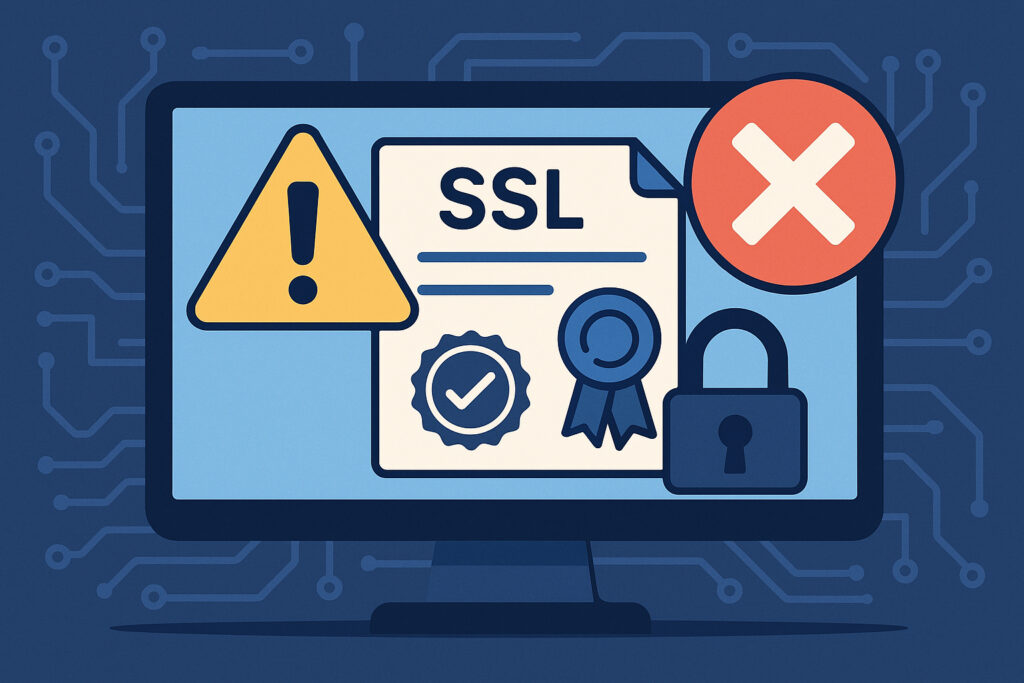
Imagine this: it’s Monday morning, you grab your coffee, and your phone starts buzzing. Customers are seeing a big red “Not Secure” warning on your website. Your sales page is effectively dead. Your contact forms aren’t working because browsers are blocking them. And somewhere in your inbox, there’s a renewal reminder you missed three weeks ago.
This isn’t a hypothetical nightmare. It happens to businesses every single day, and it’s one of the most preventable compliance failures out there.
If you run any kind of online business, especially one that handles customer data, payments, or personal information, SSL certificate expiration isn’t just a technical nuisance. It’s a compliance risk that can cost you money, customers, and credibility. The good news? It’s also one of the easiest risks to eliminate, if you have the right approach.
Why SSL Certificates Matter More Than You Think
Most people understand that SSL certificates encrypt the connection between a visitor’s browser and your server. That little padlock icon in the address bar. But what many business owners don’t realize is that SSL has become deeply intertwined with regulatory compliance.
Under GDPR, you’re required to implement appropriate technical measures to protect personal data. An expired SSL certificate means data transmitted through your site, including form submissions, login credentials, and payment details, travels unencrypted. That’s not just a security gap. It’s a potential violation that regulators can and do act on.
PCI DSS requirements are even more explicit. If you process credit card payments, maintaining valid SSL/TLS encryption isn’t optional. It’s a baseline requirement. An expired certificate can put you out of compliance instantly, and the fines aren’t small.
Then there’s the trust factor. Modern browsers don’t quietly note an expired certificate. They throw up full-page warnings that tell your visitors the site is dangerous. Studies consistently show that most users will simply leave and never come back. You don’t get a second chance to make that first impression.
A Lesson From the Trenches
I’ll be honest, I’ve seen this go wrong up close. A few years back, I was managing servers for a client who ran a mid-sized e-commerce operation. They had a wildcard certificate covering their main domain and several subdomains. The certificate was set to auto-renew, so everyone assumed it was handled.
Except the payment method on the certificate provider’s account had expired. The auto-renewal failed silently. No one noticed for two days. By then, their checkout process had been throwing security warnings for 48 hours during a weekend promotion. The revenue loss was significant, but the real damage was the customer support fallout. People thought the site had been hacked.
That experience taught me something important: trusting a single automated process without monitoring is almost as risky as not automating at all.
The Real Risks of an Expired Certificate
Let’s lay out what actually happens when your SSL certificate expires, because it goes beyond the browser warning.
Immediate loss of encrypted connections. Any data your visitors submit travels in plain text. That includes passwords, email addresses, phone numbers, and payment information.
Search engine penalties. Google has used HTTPS as a ranking signal since 2014. An expired certificate can trigger a drop in your search rankings, sometimes within hours.
Broken integrations. If your site connects to third-party APIs, payment gateways, or partner systems over HTTPS, an expired certificate can break those connections. Webhooks fail. Payment processing stops. Data syncs break down.
Regulatory exposure. As mentioned, GDPR, PCI DSS, HIPAA, and various national data protection laws all expect you to maintain encryption. An expired certificate is documented evidence that you failed to do so.
How to Stay Ahead of Certificate Expiration
Here’s a practical, step-by-step approach that actually works in real-world operations.
Step 1: Know what you have. Audit every certificate across all your domains and subdomains. Many businesses are surprised to find certificates they forgot about, especially on staging environments, old subdomains, or API endpoints.
Step 2: Centralize your tracking. Don’t rely on scattered email reminders from different certificate authorities. Use a single monitoring system that tracks all your certificates in one place with their expiration dates.
Step 3: Set up layered alerts. One reminder 30 days before expiration isn’t enough. Set alerts at 60 days, 30 days, 14 days, and 7 days. Different alerts should go to different people so nothing falls through the cracks.
Step 4: Automate renewal where possible. Let’s Encrypt and many commercial providers support automated renewal. Use it. But don’t stop there, because automation can fail.
Step 5: Monitor the monitors. This is where most people stop, and it’s exactly where things go wrong. You need an external service that independently checks whether your certificates are actually valid, not just whether a renewal was attempted.
Common Myths About SSL Certificates
“My hosting provider handles it.” Maybe. But do you know for certain? Have you verified it recently? Hosting providers change their policies, and shared hosting environments can have certificate issues that affect individual accounts.
“Auto-renewal means I never have to worry.” As my earlier story illustrates, auto-renewal can fail for a dozen different reasons: expired payment methods, DNS changes, server migrations, provider outages. It’s a good first layer, not a complete solution.
“Free certificates are less secure.” The encryption provided by Let’s Encrypt is identical in strength to expensive commercial certificates. The differences lie in validation levels and warranty, not in the actual security of the connection.
“We’ll notice if it expires.” Will you? If it happens on a Friday evening or during a holiday, who’s checking? By the time someone reports it on Monday, the damage is already done.
Where Automated Compliance Monitoring Fits In
This is exactly the kind of problem that automated monitoring was built to solve. A service like ComplianceVigil continuously checks your SSL certificates as part of a broader compliance monitoring framework. It doesn’t just check whether a certificate exists. It analyzes the certificate chain, checks expiration timelines, evaluates the strength of your TLS configuration, and alerts you well before anything becomes a problem.
The real value isn’t just in catching an expiring certificate. It’s in having a single dashboard that shows you your entire compliance posture, from SSL and security headers to privacy policies and cookie consent, so you can see gaps before they become incidents.
Frequently Asked Questions
How often should I check my SSL certificates? Daily automated checks are the standard. Manual checks once a month are a reasonable minimum if you don’t have monitoring in place, but automated daily monitoring is far more reliable.
What happens to my SEO if my certificate expires? Google can deindex HTTPS pages or drop their ranking surprisingly fast. Recovery usually happens once the certificate is restored, but it can take days or weeks to fully bounce back.
Can an expired SSL certificate lead to a data breach? Directly, it’s unlikely. But it creates conditions where data interception becomes possible, especially on public networks. More importantly, it demonstrates a lapse in security practices that regulators view unfavorably.
Is an expired certificate a GDPR violation? It can be. GDPR requires appropriate technical measures to protect personal data. If an expired certificate leads to unencrypted transmission of personal data, that’s a demonstrable failure to meet that standard.
Don’t Wait for the Warning
SSL certificate expiration is one of those problems that feels trivial until it happens to you. Then it’s urgent, stressful, and expensive. The fix isn’t complicated. Know what certificates you have, automate what you can, and monitor everything independently.
Your customers trust you with their data every time they visit your site. A valid SSL certificate is the most basic way to honor that trust. Don’t let a preventable expiration put that relationship at risk.