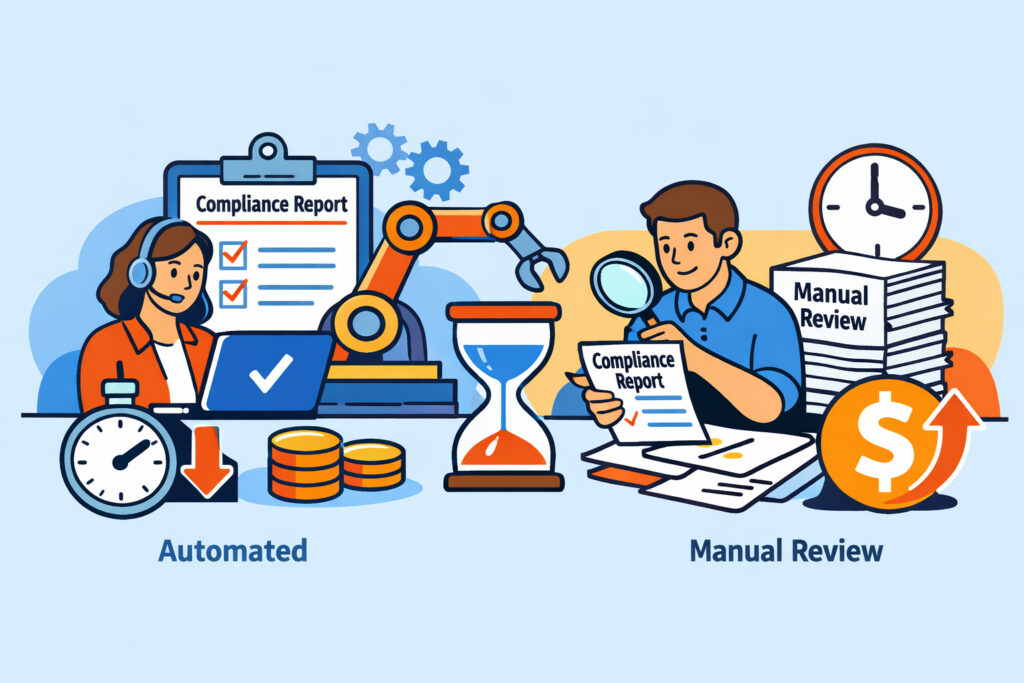
If you’re responsible for keeping a website compliant – whether that means GDPR, cookie consent, accessibility, or SSL security – you’ve probably wondered whether your current approach is actually cost-effective. The automated vs. manual compliance debate isn’t just about convenience. It’s about hard numbers: hours spent, dollars wasted, and risks that slip through the cracks. This article breaks down the real time and cost differences between automated and manual compliance monitoring so you can make an informed decision for your business.
What Manual Compliance Actually Costs
Let’s start with something most businesses underestimate: the true cost of manual compliance checking. It’s not just the salary of whoever does it. It’s the opportunity cost, the inconsistency, and the gaps that inevitably appear.
A typical manual compliance audit for a single website takes 4–8 hours when done thoroughly. That includes checking whether the privacy policy is accessible, verifying cookie consent banner functionality, reviewing security headers, confirming SSL certificate validity, and ensuring legal documents like terms of service are actually reachable. For a company managing 10 websites, that’s 40–80 hours per audit cycle.
Most compliance officers or IT staff doing this work earn between $50–$120 per hour depending on location and seniority. A single quarterly audit across 10 sites can easily cost $4,000–$9,600 in labor alone. And quarterly checks are already too infrequent – regulations don’t pause between your audits.
The hidden costs go deeper than labor. There’s the time spent documenting findings, creating reports, following up on fixes, and re-checking after changes. Manual processes also introduce human error. A tired analyst at 4 PM on a Friday will miss things that a machine catches at 3 AM on a Sunday.
The Time Gap: When Issues Go Undetected
Here’s a scenario that happens more often than anyone admits. A developer pushes a site update on Tuesday afternoon. The update accidentally breaks the cookie consent banner – it loads visually but doesn’t actually block tracking scripts until consent is given. The next manual audit is scheduled for the end of the month. For three weeks, the site is technically violating GDPR cookie consent requirements, and nobody knows.
With automated compliance monitoring, that same issue triggers an alert within minutes. The difference isn’t just speed – it’s exposure time. Three weeks of non-compliance versus three minutes. Under GDPR, regulators consider how long a violation persisted when calculating penalties. A brief, quickly remediated issue looks very different from one that ran unchecked for weeks.
This time gap is the single biggest argument against relying solely on manual audits. Websites aren’t static. They change constantly – CMS updates, plugin changes, content edits, certificate renewals. Each change is a potential compliance event, and one-time audits simply can’t keep pace with that reality.
Automated Compliance: Real Numbers
Automated monitoring platforms like ComplianceVigil run checks continuously – 24/7, 365 days a year. A single platform can monitor dozens or hundreds of sites simultaneously across multiple compliance dimensions: legal document availability, cookie consent functionality, SSL certificate status, security headers, accessibility statements, and business ID visibility.
The cost comparison is stark. Where manual auditing might run $16,000–$38,000 annually for 10 sites (assuming quarterly checks), an automated monitoring solution typically costs a fraction of that – often 80–90% less. But the savings aren’t just financial. Consider the time your team reclaims.
Instead of spending 40–80 hours per quarter on repetitive checks, your compliance officer spends 2–3 hours reviewing automated reports and addressing flagged issues. That’s a shift from reactive auditing to proactive management. Your team focuses on fixing problems and improving compliance posture rather than hunting for issues.
Busting the “Automated Means Impersonal” Myth
One misconception I hear regularly: “Automated tools just run generic scans – they can’t understand our specific compliance needs.” This made sense maybe a decade ago, but modern compliance monitoring is far more sophisticated.
ComplianceVigil, for example, doesn’t just check whether a page loads. It verifies whether cookie consent banners actually function correctly at a technical level – not just whether they appear visually. It monitors whether your privacy policy is accessible, not just whether the URL returns a 200 status code. This is the smart alternative to manual audits – purpose-built monitoring that understands compliance context, not just HTTP responses.
Automated doesn’t mean hands-off. It means your human expertise is applied where it matters most: interpreting results, making strategic decisions, and handling edge cases – not clicking through the same 50-point checklist every quarter.
Side-by-Side Comparison
Here’s how the two approaches stack up across key metrics:
Detection speed: Manual audits catch issues on a schedule – weekly, monthly, or quarterly. Automated monitoring catches issues in real time, often within minutes.
Coverage consistency: Manual checks vary by who performs them and when. Automated checks run identically every time, across every monitored dimension.
Annual cost for 10 sites: Manual auditing runs $16,000–$38,000+ in labor. Automated monitoring typically costs $1,000–$4,000 annually depending on the platform and plan.
Scalability: Adding five more sites to a manual process means 50% more labor. Adding five more sites to an automated platform is often just a configuration change.
Compliance gap duration: Manual processes leave gaps of days to weeks. Automated monitoring reduces gaps to minutes.
Understanding the ROI of automated compliance monitoring becomes obvious once you lay these numbers side by side.
When Manual Checks Still Make Sense
To be fair, automated monitoring doesn’t eliminate the need for human judgment entirely. Complex accessibility audits, nuanced legal interpretations, and policy reviews still benefit from expert human analysis. The ideal approach is a hybrid: automated monitoring handles the continuous, repetitive, high-frequency checks while human experts focus on strategic reviews, policy updates, and complex compliance questions that require interpretation.
The mistake is relying exclusively on one approach. Manual-only means gaps and high costs. Automated-only might miss context that requires human understanding. The winning combination uses automation as the foundation and human expertise as the overlay.
FAQ
How much time does switching to automated compliance monitoring actually save?
Most businesses report saving 70–85% of the time previously spent on manual compliance checks. For a team spending 40 hours per quarter on audits, that typically drops to 6–10 hours focused on reviewing reports and acting on findings rather than performing the checks themselves.
Can automated monitoring replace our compliance officer?
No – and it shouldn’t. Automated monitoring replaces the repetitive, manual checking work. Your compliance officer becomes more effective because they spend their time on analysis, strategy, and remediation instead of routine audits. Think of it as giving them better tools, not replacing their role.
What’s the biggest risk of sticking with manual-only compliance?
The detection delay. Between scheduled audits, compliance issues can persist unnoticed for days or weeks. Under regulations like GDPR, the duration of a violation directly affects penalty severity. Continuous automated monitoring closes that gap almost entirely.
The bottom line is straightforward. Manual compliance auditing is slow, expensive, and leaves dangerous gaps between checks. Automated monitoring is faster, cheaper, more consistent, and scales effortlessly. The real cost analysis isn’t whether you can afford to automate – it’s whether you can afford not to.