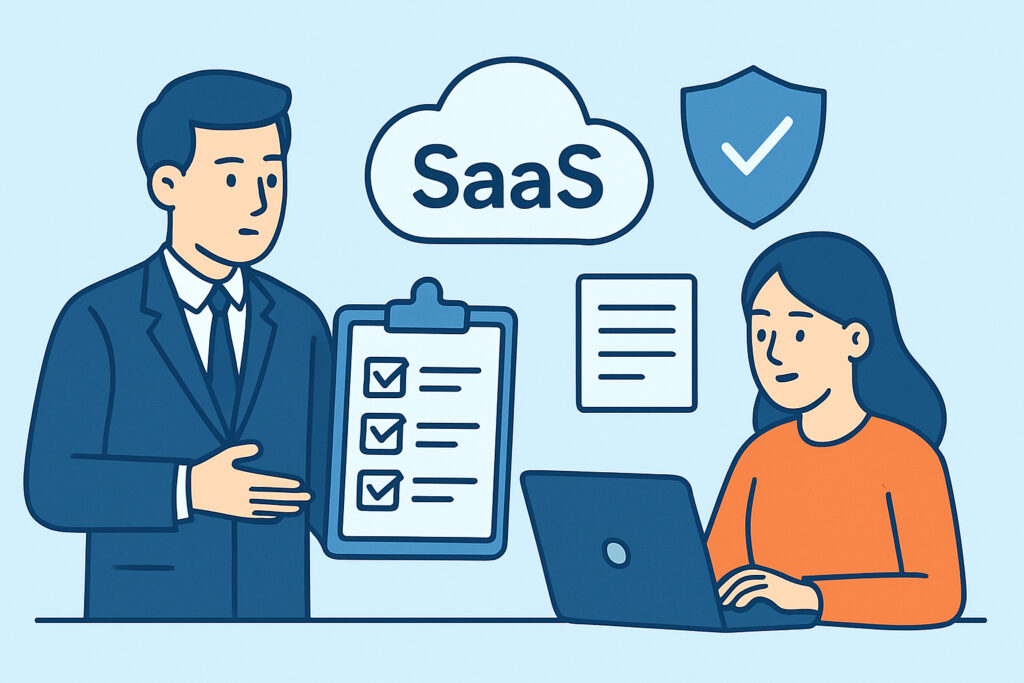
Compliance for SaaS companies presents a distinct set of challenges that traditional brick-and-mortar businesses rarely face. When your product is delivered entirely over the internet, your legal and technical obligations multiply – often across jurisdictions, user types, and data categories that evolve with every product update. This article covers what makes SaaS compliance different, which areas demand the closest attention, and what patterns consistently lead to costly gaps.
Why SaaS Compliance Is More Complex Than Most Assume
A SaaS business is not simply a company with a website – it’s a data processor, a service provider, and often a sub-processor for its customers’ customers. That layered structure means compliance obligations stack on top of each other in ways that aren’t always obvious from reading a single regulation.
Consider a SaaS platform serving clients in the EU, the US, and Australia. Each jurisdiction brings its own requirements: GDPR in Europe, CCPA in California, and the Australian Privacy Act elsewhere. Managing these simultaneously while shipping regular product updates is genuinely difficult – and most teams underestimate how fast compliance state can degrade.
The Website Compliance Layer That Often Gets Overlooked
Technical and legal teams inside SaaS companies tend to focus on data handling, security certifications like SOC 2 or ISO 27001, and vendor contracts. What often slips through is the compliance state of the public-facing website itself – the privacy policy, cookie consent behavior, terms of service accessibility, and security headers.
These are not just cosmetic concerns. A privacy policy that disappears after a content management system update, or a cookie consent banner that looks correct but fails technically, can trigger regulatory attention just as quickly as a data breach. Multi-layer compliance failures are especially common in SaaS environments, where frequent deployments increase the chance of something breaking without anyone noticing.
Data Processing Agreements – A Non-Negotiable for SaaS
One of the most common compliance oversights for SaaS companies is inadequate coverage of data processing agreements (DPAs). Under GDPR, if your product processes personal data on behalf of your customers, you are acting as a data processor – and that relationship must be documented in a formal DPA.
Many SaaS teams assume their standard terms of service cover this. They don’t. A DPA must include specific provisions: the subject matter and duration of processing, the nature and purpose of processing, the type of personal data involved, and obligations on both sides. Without this, every customer relationship in the EU represents a compliance gap.
Cookie Consent – Where Technical and Legal Reality Diverge
Cookie consent is one of the most misunderstood compliance requirements in the SaaS world. Many teams believe that if the banner appears and looks reasonable, the obligation is met. That’s a myth.
Regulators assess consent based on technical behavior: whether non-essential cookies fire before consent is given, whether the consent log is stored correctly, whether withdrawal of consent is as easy as granting it. A banner can look perfect while the underlying script behavior violates GDPR’s consent requirements entirely. This gap between visual compliance and technical compliance has caught a significant number of SaaS companies off guard during audits.
Security Headers and SSL – Not Just a Technical Best Practice
Security headers like Content-Security-Policy, X-Frame-Options, and Strict-Transport-Security are increasingly treated as compliance requirements rather than optional hardening measures. Regulators assessing GDPR’s Article 32 – which mandates “appropriate technical measures” – have cited missing security headers as evidence of inadequate security posture.
SSL certificate expiration is a related risk that SaaS companies often handle poorly. Automated renewal through Let’s Encrypt or similar services works reliably – until it doesn’t. A certificate that lapses creates both a user-facing warning and a compliance signal to any regulator reviewing your technical posture. GDPR compliance automation that includes certificate and header monitoring catches these issues before they escalate.
The Continuous Change Problem
SaaS companies ship code constantly. Weekly releases, hotfixes, A/B tests, third-party script updates – every one of these can silently alter the compliance state of the website. A privacy policy link that worked yesterday can break after a template change. A cookie consent configuration can revert to a previous state after a CMS rollback.
This is why point-in-time compliance audits are fundamentally inadequate for SaaS environments. Automated compliance monitoring that runs continuously provides coverage that manual spot-checks cannot – detecting changes as they happen rather than weeks later during the next scheduled review.
Multi-Jurisdiction Considerations
Most SaaS companies expand internationally faster than their compliance frameworks keep up. A platform that starts serving US customers and later picks up European clients faces a sudden set of obligations it may not have prepared for: GDPR consent requirements, right-to-erasure processes, data residency documentation, and updated privacy disclosures.
The website itself needs to reflect this. Consumer rights notices that satisfy California requirements may not satisfy German or Finnish ones. Terms of service that work for US users may need substantial revision for EU customers. Getting ahead of this requires knowing what’s live on the website at any given time – not what was published six months ago.
Practical Steps for SaaS Compliance Teams
These priorities tend to apply broadly across SaaS businesses regardless of size:
Audit your website compliance layer separately from your data compliance layer. They share some overlap but are governed by different processes and often different teams. Website compliance gaps – missing legal documents, broken consent flows, weak security headers – need their own monitoring cadence.
Treat every deployment as a potential compliance event. Build a checklist that covers the key compliance-sensitive pages: privacy policy, terms of service, cookie consent behavior, business registration details, accessibility statement. Verify these are intact after every significant change.
Document your sub-processor chain. If your SaaS product uses third-party services that process personal data – analytics tools, payment processors, email platforms – each one needs to be reflected in your DPA and disclosed in your privacy policy. This list changes regularly and needs active management.
Monitor SSL and security headers continuously, not just when something looks wrong. Certificate issues and header misconfigurations are silent – they don’t generate support tickets until users start seeing browser warnings or until a regulator asks for evidence of technical safeguards.
A Common Misconception Worth Addressing
One persistent misconception is that SOC 2 certification replaces GDPR compliance. It doesn’t. SOC 2 is a framework for demonstrating controls around security, availability, and confidentiality to enterprise customers – it addresses different obligations than data protection law and doesn’t cover the legal requirements around consent, privacy notices, or data subject rights. Both matter; neither substitutes for the other.
Another misconception: that small SaaS companies are too small to attract regulatory attention. Regulators across Europe and the US have demonstrated a clear willingness to issue findings against small operators, particularly when the violation is visible and easy to document – an absent privacy policy, a cookie wall with no real opt-out, a lapsed SSL certificate.
Frequently Asked Questions
Does a SaaS company need a separate privacy policy for each market it serves?
Not necessarily a separate document, but the policy must address the requirements of each relevant jurisdiction. A single policy that includes GDPR-specific disclosures alongside CCPA-required information can work, provided all required elements are present for each applicable law and the document remains accessible to all users.
How often should a SaaS company review its website compliance?
Every deployment is an opportunity for compliance state to change, so monitoring needs to be continuous rather than periodic. A formal review of the compliance framework itself – covering legal documents, data flows, and vendor contracts – makes sense at least quarterly, or after any significant product change that affects data handling.
What happens if a SaaS company’s privacy policy becomes temporarily unavailable due to a technical error?
Unavailability of required legal documents is treated as a compliance failure regardless of intent. Regulators assess what was accessible to users at a given time, not what the company intended to publish. Even short outages carry risk, which is why availability monitoring for legal documents is a distinct compliance requirement, not a general uptime concern.
Summary
Compliance for SaaS companies demands attention at multiple levels simultaneously – data handling, legal documentation, technical implementation, and website availability. The most common failures aren’t the dramatic ones; they’re quiet regressions after deployments, consent banners that fail technically while looking fine visually, and legal documents that go missing for hours or days without anyone on the team noticing. Building monitoring into the deployment cycle rather than treating compliance as a periodic audit is what separates companies that stay ahead of these issues from those that only discover them when regulators or customers raise concerns.