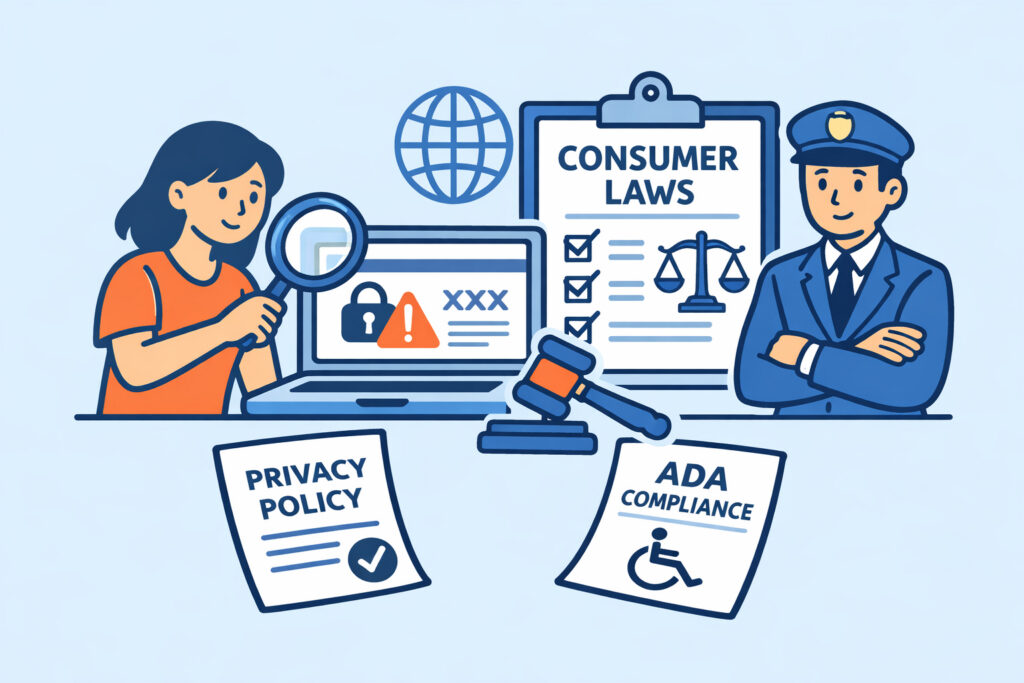
Consumer protection laws increasingly dictate what your website must display – and how it must display it. If you run an online business, understanding how consumer protection laws affect your website display isn’t optional anymore. Getting it wrong can lead to regulatory fines, lost customer trust, and legal headaches that take months to resolve.
Most website owners focus on having the right legal pages somewhere on their site. But regulators don’t just check whether a privacy policy exists – they check whether visitors can actually find and read it at any given moment. That distinction catches more businesses off guard than you’d expect.
What Consumer Protection Laws Actually Require on Your Website
Consumer protection regulations vary by jurisdiction, but the core requirements overlap significantly. In the EU, the GDPR and ePrivacy Directive set strict rules for data handling disclosures and cookie consent. In the US, state-level laws like the CCPA and newer state privacy acts mandate clear consumer rights notices. Across all of these frameworks, the common thread is transparency – your website must clearly communicate what data you collect, how you use it, and what rights consumers have.
Here’s what that looks like in practice. Your site typically needs to display:
A functioning cookie consent mechanism that blocks non-essential cookies until consent is given. A privacy policy that’s accessible from every page. Terms of service with clear language about consumer rights. Business identification information – company name, registration number, contact details. And in many jurisdictions, a visible way for consumers to exercise their data rights.
The critical word there is “functioning.” A cookie banner that looks correct but doesn’t actually block tracking scripts is a compliance failure. A privacy policy link in your footer that returns a 404 after a site update is a compliance failure. These aren’t hypothetical scenarios – they’re the most common issues compliance officers discover during audits.
The Myth of “Set It and Forget It” Compliance
Here’s the misconception that gets businesses in trouble: many assume that once their legal pages are published and their cookie banner is installed, they’re done. Compliance is treated as a one-time project rather than an ongoing responsibility.
Reality is far messier. WordPress plugin updates can break cookie consent functionality overnight. A CMS migration might silently drop your terms of service page. A developer deploying a new feature could accidentally remove the business ID from your footer template. These things happen constantly – not because anyone is negligent, but because websites are dynamic environments where small changes create unexpected side effects.
I’ve seen situations where a company redesigned their navigation menu and inadvertently removed the link to their consumer rights notifications page. Nobody noticed for three weeks. By the time a customer complained to the regulator, the company had no documentation proving the page had been accessible before. That’s the kind of gap that turns a minor oversight into a formal investigation.
How Consumer Protection Laws Affect Your Website Display in Practice
Let’s get specific about the display requirements that trip up real businesses.
Cookie consent banners must do more than appear on screen. Under GDPR enforcement guidance, they need to offer genuine choice – no pre-ticked boxes, no dark patterns that make “Accept All” visually dominant over “Reject.” The technical implementation matters as much as the visual design. If your banner displays correctly but the underlying scripts fire tracking cookies before consent, you’re non-compliant. Understanding the difference between technical implementation and visual appearance of cookie consent is essential.
Privacy policy accessibility means more than having the document on your server. Regulators expect it to be reachable within one or two clicks from any page, load reliably, and be written in plain language. If your privacy policy is a PDF that takes 30 seconds to download on mobile, that’s a problem.
Terms of service visibility has become a focus area for consumer protection agencies. Courts have increasingly ruled that terms buried behind multiple navigation layers aren’t enforceable. Your terms of service must be consistently available – not just present, but accessible in a way a reasonable consumer would find them.
Business identification requirements vary by country but are strictly enforced in the EU under the eCommerce Directive. Your company name, registration number, VAT ID, and physical address must be displayed prominently. Missing any of these during a regulatory check can trigger immediate action.
The Real Cost of Display Non-Compliance
Fines get the headlines, but they’re rarely the biggest cost. Under GDPR, penalties can reach €20 million or 4% of global turnover. But for most mid-sized businesses, the real damage comes from three other sources.
First, there’s the operational disruption. When a regulator opens an investigation, your legal team and IT department get pulled into documentation requests, response deadlines, and remediation plans. That’s weeks of productive time gone.
Second, there’s reputational damage. Consumers increasingly check whether businesses take compliance seriously. A publicly reported violation – even a minor one – erodes the trust you’ve spent years building.
Third, there’s the cascading effect. One compliance gap often reveals others. A regulator investigating a cookie consent issue might also discover your accessibility statement is missing or your GDPR compliance has other gaps that compound the original problem.
Practical Steps to Stay Compliant
Keeping your website display aligned with consumer protection laws requires a systematic approach rather than periodic spot checks.
Audit your current state thoroughly. Document every legal page, every consent mechanism, and every required disclosure on your site. Note where each element is linked from and how it’s accessed on mobile versus desktop.
Monitor continuously, not periodically. Manual compliance checks done quarterly or even monthly leave dangerous gaps. A broken cookie banner on a Friday evening won’t wait until your next audit. Automated compliance monitoring catches issues in real time – the moment a required page goes down or a consent mechanism breaks.
Test after every deployment. Build compliance verification into your release process. Every code push, plugin update, or content change should trigger a check that all legally required elements still display and function correctly.
Document everything. Regulators look favorably on businesses that can demonstrate proactive monitoring and rapid remediation. Keeping logs of your compliance status over time – what was checked, when, and what was found – creates a defensible record.
FAQ
Which consumer protection laws apply to my website if I serve customers in multiple countries?
Generally, you must comply with the laws of every jurisdiction where your customers are located – not just where your business is registered. For EU customers, GDPR applies regardless of where your company is based. For California residents, CCPA applies. The safest approach is to meet the strictest applicable standard, which typically means GDPR-level compliance for display and disclosure requirements.
How quickly do I need to fix a compliance display issue once it’s detected?
There’s no universal deadline written into most laws, but regulators assess whether you acted “without undue delay.” In practice, fixing a broken privacy policy link or malfunctioning cookie banner within hours demonstrates good faith. Letting it persist for days or weeks suggests negligence. Automated monitoring with instant alerts is the most reliable way to minimize response time.
Can I be fined if my website was compliant when originally built but broke due to a software update?
Yes. Regulators evaluate compliance at the time of the violation, not at the time of initial setup. A plugin update that disables your cookie consent mechanism creates immediate liability regardless of your original implementation. This is exactly why continuous monitoring matters – your compliance status can change at any moment without anyone on your team making a deliberate change.
Staying on top of consumer protection display requirements isn’t about checking boxes once a year. It’s about maintaining constant visibility into what your website actually shows visitors right now – not what it showed them last time someone checked. The businesses that treat compliance as an ongoing process rather than a finished project are the ones that avoid surprises.