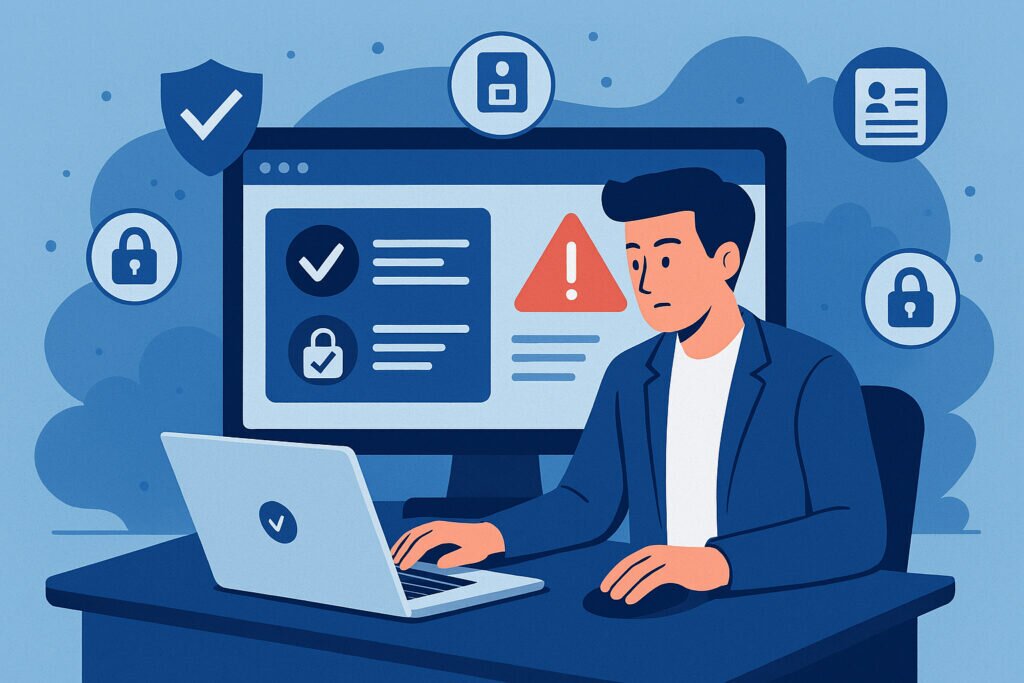
Real-time compliance monitoring is the practice of continuously checking your website for legal, technical, and regulatory issues as they happen – rather than discovering them days or weeks later through a complaint, audit, or customer report. This article covers how real-time monitoring works in practice, why delayed detection is one of the costliest mistakes a website owner can make, and what a proactive compliance posture actually looks like.
Most compliance problems don’t announce themselves. A privacy policy link breaks during a CMS update. A cookie consent banner stops firing correctly after a third-party script change. An SSL certificate quietly expires over a weekend. By the time anyone notices, the damage – to legal standing, to customer trust, and sometimes to revenue – is already done.
The Window Between a Problem Appearing and Someone Noticing
There’s a critical period between the moment a compliance issue appears on a website and the moment it gets reported or discovered. In manual audit workflows, that window can be days or even weeks. During that time, visitors are interacting with a site that may be collecting data without valid consent, displaying broken legal documents, or operating with an expired security certificate.
This is where real-time compliance monitoring fundamentally changes the equation. Instead of periodic snapshots – a monthly manual review, a quarterly audit – continuous monitoring checks compliance status around the clock. The moment something changes, the right people know.
A practical example: a European e-commerce site undergoes a routine platform migration on a Thursday evening. The migration inadvertently redirects the privacy policy URL to a 404 page. Without real-time monitoring, this might go undetected until the following Monday when the compliance team runs their weekly check – four days of potential GDPR exposure. With real-time detection, the alert arrives within minutes.
What Real-Time Monitoring Actually Covers
The phrase “real-time monitoring” is sometimes narrowly understood as just uptime monitoring – checking whether a page loads. That’s a misconception worth addressing directly. Uptime is a starting point, not a compliance strategy.
Effective real-time compliance monitoring operates across multiple layers simultaneously:
Legal document availability – Privacy policies, terms of service, and cookie policies must not only exist but remain accessible at all times. A document that returns a 404 or gets buried behind a login wall is a compliance failure even if the content itself is correct.
Cookie consent functionality – The banner has to work technically, not just visually. A consent banner that appears but fails to actually block non-essential cookies before consent is given is a compliance violation. This is one of the most common technical failures that visual checks entirely miss – and cookie consent monitoring that goes beyond visual verification is essential for catching it.
SSL certificate integrity – An expired or misconfigured certificate affects both security and legal compliance, particularly under data protection regulations that require appropriate technical safeguards.
Security headers – Headers like Content-Security-Policy, X-Frame-Options, and Strict-Transport-Security aren’t optional decorations. Their absence creates exploitable vulnerabilities and, in some regulatory frameworks, constitutes non-compliance.
Consumer rights notices and business registration details – These are frequently overlooked. Many jurisdictions require visible display of business ID numbers, registered addresses, and consumer rights information. These details can disappear quietly during template updates or A/B tests.
Why Reactive Compliance Is a Liability
The traditional reactive model – waiting for something to break badly enough to be noticed – carries compounding risks. Regulatory bodies increasingly expect businesses to demonstrate proactive compliance management, not just clean results at audit time.
Under GDPR, for instance, the expectation is that data protection is built into operations, not bolted on after the fact. Supervisory authorities have taken a dim view of situations where organizations only corrected a compliance failure after it was flagged externally. The attitude of “we fixed it when we found out” is increasingly insufficient as a defense.
There’s also the customer trust angle. A visitor who encounters a broken privacy policy link, a non-functional consent mechanism, or a browser security warning is unlikely to complete a purchase or provide personal information. The compliance failure becomes a conversion failure, quietly bleeding revenue before anyone on the business side is even aware there’s a problem.
Setting Up a Real-Time Compliance Workflow
Moving from reactive to proactive compliance monitoring involves a few concrete steps:
Step 1 – Establish a compliance baseline. Before monitoring can flag deviations, you need to know what “correct” looks like for your site. Document which legal pages exist, what URLs they live at, what consent mechanisms are in place, and which security headers are configured. A structured compliance checklist helps ensure nothing is overlooked.
Step 2 – Configure continuous checks across all compliance layers. Don’t rely on single-point monitoring. SSL certificates, legal document availability, cookie consent behavior, security headers, and consumer-facing notices all need independent monitoring with appropriate check frequencies.
Step 3 – Set up actionable alerts. An alert that tells you “something changed” is less useful than one that tells you exactly what changed, what the compliance implication is, and what remediation looks like. Vague notifications lead to delayed responses.
Step 4 – Define response ownership. Real-time alerts are only valuable if someone acts on them. Establish who receives compliance alerts, what their response time obligation is, and what escalation looks like if the first responder is unavailable.
Step 5 – Log everything. Compliance monitoring logs serve as evidence of good-faith oversight. In a regulatory investigation or customer dispute, the ability to show timestamps of when an issue was detected and when it was resolved is meaningful documentation.
The Myth That Compliance Only Breaks During Major Updates
One dangerous assumption is that compliance issues only surface when significant changes happen – a full site rebuild, a new CMS deployment, a major legal update. In reality, minor changes break compliance constantly.
A plugin auto-update that modifies how scripts load. A marketing team member editing a page template to improve conversion rates. A CDN configuration tweak by a developer optimizing performance. Any of these routine, low-visibility actions can quietly break a consent mechanism, remove a legal notice, or alter a security header without triggering any formal change management process.
This is precisely why website updates and compliance risks must be treated as an ongoing relationship, not a one-time concern. The monitoring can’t have gaps just because no “official” changes were planned.
Frequently Asked Questions
How quickly should a real-time compliance monitoring system detect an issue?
Detection within minutes is the practical standard for high-risk compliance elements like SSL certificates and legal document availability. Longer detection windows – hours or days – significantly increase exposure, particularly under data protection regulations where breach notification timelines are strict.
Does real-time monitoring replace periodic compliance audits?
No, but it changes their role. Continuous monitoring handles ongoing detection and alerting. Periodic audits become useful for deeper analysis, regulatory review preparation, and updating the compliance baseline when laws or business practices change. The two approaches work together rather than substituting for each other.
What happens if a compliance issue is detected outside business hours?
This is where alert routing matters. Real-time monitoring is only effective if alerts reach someone who can act, regardless of when the issue occurs. Configuring escalation paths for after-hours detection – whether through on-call systems, automated responses, or redundant notification channels – is a critical part of any monitoring setup.
The Practical Value of Getting There First
The fundamental shift that real-time compliance monitoring enables is simple: your team finds the problem before your customers, regulators, or competitors do. That window – even if it’s just a few hours – is the difference between a managed incident and a public compliance failure.
Compliance issues will always occur. Updates happen, third-party scripts misbehave, certificates expire. The organizations that handle compliance well aren’t necessarily the ones with the fewest problems – they’re the ones with the fastest, most reliable systems for detecting and correcting them. Real-time monitoring is the infrastructure that makes that possible.