If you run a website that collects any form of user data, handles transactions, or simply operates within the EU or other regulated markets, you already know the compliance landscape is not getting simpler. But here is something many business owners get wrong: they treat compliance as a project with a finish line. You audit once, fix the issues, check the boxes, and move on. I used to think the same way, and it cost me time, stress, and very nearly a client relationship I valued.
The truth is that compliance is not a destination. It is a condition that must be maintained every single day your website is live. And the business case for monitoring it continuously is not abstract or theoretical. It is practical, financial, and frankly, a matter of survival in a digital economy where regulators and customers alike have zero patience for negligence.
Why point-in-time audits are no longer enough
Think about what happens to a typical website in a single month. Your development team pushes an update. A plugin auto-updates and silently breaks your cookie consent banner. Someone edits a landing page and accidentally removes the link to your privacy policy. Your SSL certificate is three weeks from expiry and nobody has a reminder set.
Each of these is a real scenario I have encountered. Not hypothetically, but on production websites serving real customers. The problem with annual or even quarterly audits is that they only capture a snapshot. Between snapshots, your site drifts. It is not malice, it is just the natural entropy of a living, breathing web property. And in that drift, violations hide.
A single broken cookie consent mechanism can mean you are collecting tracking data without permission. Under GDPR, that is not a technicality. It is a violation that can carry fines up to four percent of annual global turnover. For many businesses, one incident like this could wipe out an entire quarter of profit.
The real costs of non-compliance
Let me break this down in terms that hit the balance sheet. The direct costs of non-compliance include regulatory fines, legal fees, and remediation expenses. But the indirect costs are often worse. Customer churn after a data breach or privacy scandal. Lost deals because a prospective enterprise client ran a security check on your site and found missing security headers. Damaged brand reputation that takes years to rebuild.
There is also the cost of reactive firefighting. When a compliance issue surfaces unexpectedly, perhaps through a customer complaint or a regulatory inquiry, your team drops everything. Development priorities get reshuffled. Legal counsel gets involved. Management time gets consumed. The disruption to normal business operations is significant and entirely avoidable.
A personal lesson in what can go wrong
A few years back, I was managing a portfolio of web properties and assumed that because we had done a thorough compliance review at launch, we were in good shape. Six months later, I discovered that a routine CMS update had altered how our cookie consent tool loaded. For weeks, the banner was technically present but not actually blocking scripts before consent was given. We were collecting analytics data on every visitor without valid permission.
Nobody noticed because nobody was checking. The fix itself took twenty minutes. But the realization that we had been out of compliance for weeks, with thousands of page views during that period, was a wake-up call. That is when I understood that compliance monitoring cannot be a calendar reminder. It needs to be automated, continuous, and immediate.
What continuous compliance surveillance actually looks like
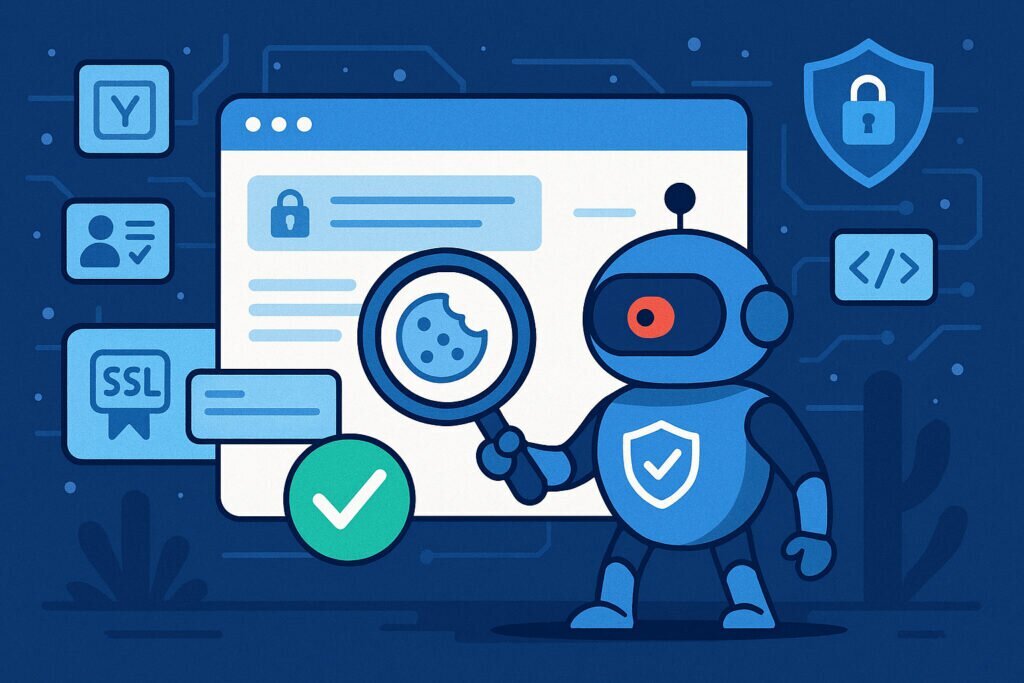
Continuous monitoring means your website is being checked regularly and automatically across multiple compliance dimensions. Not once a year, not once a month, but on an ongoing basis. A proper surveillance system should cover at minimum the following areas.
Legal document availability: Are your privacy policy, terms of service, and business identification details accessible and up to date? These are baseline legal requirements in most jurisdictions, and a missing page can trigger regulatory attention.
Cookie consent functionality: Not just whether a banner exists, but whether it actually works. Does it block tracking scripts before consent is given? Does it respect the user’s choice? Many sites have banners that look compliant but fail technically.
SSL and security posture: Is your certificate valid and properly configured? Are your security headers set correctly to protect against common attacks? These are not just security concerns but increasingly compliance requirements under frameworks like PCI DSS and various national cybersecurity regulations.
Accessibility compliance: Does your site provide an accessibility statement? Are you meeting the obligations set by legislation like the European Accessibility Act? This area is rapidly becoming a legal requirement rather than a nice-to-have.
Timely alerting with actionable guidance: When something breaks, you need to know immediately, and you need to know what to do about it. A good monitoring system does not just flag problems. It tells you how to fix them.
Breaking the myth that compliance is only for large enterprises
One of the most persistent misconceptions is that compliance monitoring is something only big corporations need to worry about. In reality, small and mid-sized businesses are often at greater risk precisely because they lack dedicated compliance teams. A large enterprise might have a legal department reviewing these issues quarterly. A small business owner is juggling product development, sales, and customer support, and compliance falls through the cracks.
Automated surveillance levels the playing field. It gives a five-person company the same ongoing oversight that a legal team of twenty would provide, at a fraction of the cost.
Frequently asked questions
Is manual checking not sufficient if I have a small site? Even small sites change over time. Plugin updates, content edits, and certificate renewals all introduce risk. Manual checking is unreliable because it depends on someone remembering to do it at the right time.
How quickly do compliance issues typically appear after a site change? Instantly. A single deployment can break a consent mechanism or remove a required legal page. Without monitoring, these issues can persist for weeks or months before discovery.
Does continuous monitoring replace the need for legal advice? No. Monitoring tools detect technical and structural compliance issues. You still need legal counsel to ensure your policies and practices meet the specific requirements of your jurisdiction. Think of monitoring as the early warning system that keeps you out of trouble between legal reviews.
What if I operate in multiple jurisdictions? That makes continuous monitoring even more critical. Requirements vary across regions, and keeping track of all obligations manually across multiple regulatory frameworks is practically impossible without automation.
The bottom line
Continuous compliance surveillance is not an expense. It is insurance against fines, reputation damage, and the hidden costs of reactive crisis management. It turns compliance from a source of anxiety into a managed, predictable part of your operations. And it frees you to focus on what actually grows your business, knowing that the regulatory side of things is being watched every hour of every day.
The businesses that will thrive in the coming years are not the ones that scramble to fix compliance failures after the fact. They are the ones that never let those failures happen in the first place.