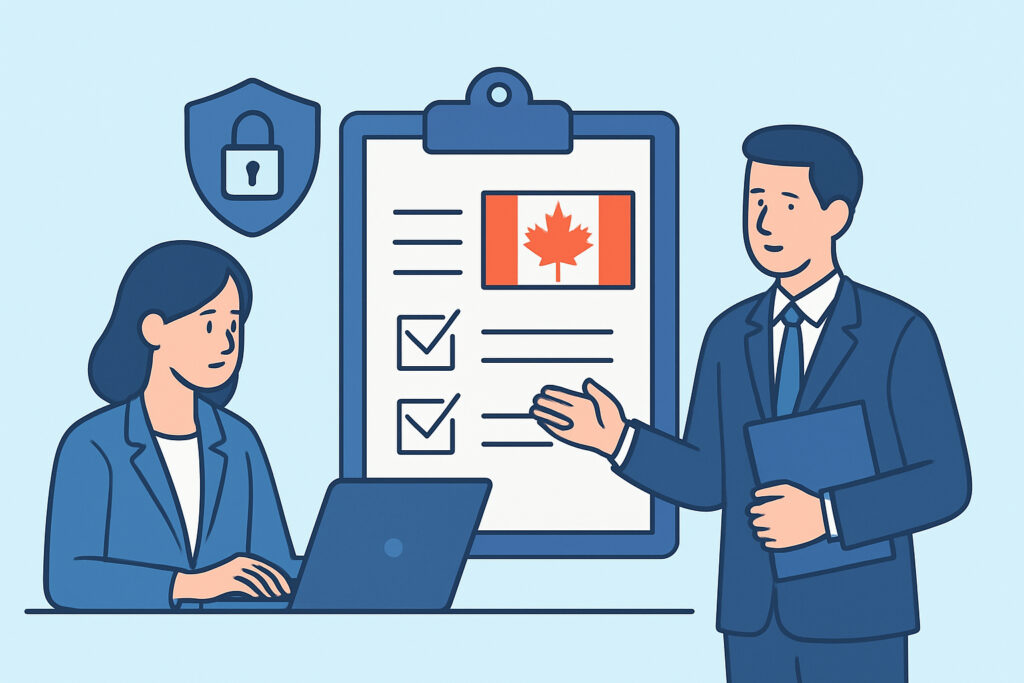
Canadian businesses collecting personal information online – whether they’re based in Toronto or simply selling to customers in Ontario or British Columbia – fall under the Personal Information Protection and Electronic Documents Act, and PIPEDA compliance is not optional once you cross certain thresholds of commercial activity. Understanding what the law actually requires, rather than relying on assumptions borrowed from GDPR or CCPA, is the difference between a defensible privacy program and a costly gap that surfaces during a complaint investigation.
PIPEDA applies to private-sector organizations that collect, use, or disclose personal information in the course of commercial activity across Canada. Unlike some provincial laws (Quebec’s Law 25, Alberta’s PIPA, and BC’s PIPA operate somewhat differently for organizations based in those provinces), PIPEDA is the federal baseline and applies by default unless a substantially similar provincial law takes precedence.
What PIPEDA actually requires from a website
At its core, PIPEDA is built around ten fair information principles, but for a website operator the practical requirements boil down to a handful of concrete obligations.
Consent must be meaningful. This means visitors need to understand what is being collected and why before they agree – a vague “we use cookies” banner with no real choice does not meet the bar. Purpose limitation requires that data collected for one reason (say, order fulfillment) isn’t quietly repurposed for marketing without fresh consent.
Organizations must also be able to name an accountable individual – often a privacy officer – who is responsible for compliance, and that contact information typically needs to be findable, usually within the privacy policy itself. Individuals have the right to access their personal information and challenge its accuracy, so there needs to be a functioning process behind any “contact us to access your data” line, not just the sentence itself.
Breach reporting is one of PIPEDA’s sharper teeth: organizations must report breaches of security safeguards to the Office of the Privacy Commissioner and notify affected individuals when there’s a real risk of significant harm, and they must keep records of every breach, even ones that don’t meet the reporting threshold.
Common mistake: treating PIPEDA as “GDPR-lite”
A recurring misconception is that satisfying GDPR automatically satisfies PIPEDA, so teams copy-paste a European privacy policy, swap “EU” for “Canada,” and consider the job done. This is a myth worth busting directly: PIPEDA doesn’t include the same prescriptive lawful-basis framework as GDPR, doesn’t have a direct equivalent to the GDPR’s 72-hour breach notification clock, and defines consent somewhat differently, with more room for implied consent in certain low-sensitivity contexts. A policy written purely for European scrutiny can end up either over-promising rights Canadian law doesn’t grant in the same form, or missing PIPEDA-specific language around the accountable individual and the complaint process to the Privacy Commissioner. The safer approach is drafting Canadian-specific language, even if the underlying data practices are the same across jurisdictions.
A practical scenario
Consider a mid-sized eCommerce retailer based in Alberta that ships across Canada and into a few US states. The team assumes PIPEDA compliance is handled because they already built a GDPR-compliant cookie banner for European visitors years earlier. During a routine review, it turns out the privacy policy still references “EU data subjects” exclusively, there’s no named privacy officer, and the breach response plan was never adapted for PIPEDA’s notification requirements. None of this was intentional negligence – it was simply a case of one jurisdiction’s framework silently drifting out of alignment as the business expanded, with nobody re-checking the original policy against Canadian requirements specifically.
Step-by-step: getting a website PIPEDA-ready
Start by confirming applicability – if any commercial activity touches Canadian residents’ personal information, PIPEDA (or a substantially similar provincial law) likely applies. Next, audit what data is actually collected across forms, checkout flows, analytics, and marketing tools, since you cannot document consent for collection you haven’t inventoried.
Then draft or update the privacy policy to explicitly name PIPEDA, describe the purposes of collection in plain language, and identify the accountable individual with a working contact method. After that, review consent mechanisms – cookie banners, newsletter opt-ins, checkout consent checkboxes – to confirm they require an affirmative action rather than relying on silence or pre-checked boxes for anything beyond strictly necessary functions.
Build or update an incident response process that specifically addresses PIPEDA’s breach reporting duties to the OPC, including a record-keeping mechanism for breaches that fall below the reporting threshold. Finally, put a monitoring routine in place so that when the site changes – a new form, a new marketing pixel, a redesigned checkout – someone actually checks whether the privacy policy and consent flows still reflect reality, since routine website updates are one of the most common ways compliance gaps quietly open up.
Where this connects to broader data flows
Many Canadian businesses use vendors, cloud providers, or SaaS tools hosted outside Canada, which raises questions about cross-border transfers even though PIPEDA doesn’t impose a formal adequacy mechanism the way GDPR does. Organizations remain accountable for personal information transferred to third parties for processing, meaning contracts with those vendors matter – a topic closely related to how standard contractual clauses function for international data transfers more broadly, even outside a strict PIPEDA context.
It’s also worth keeping the privacy policy itself under continuous scrutiny rather than treating it as a document written once and forgotten, since privacy policy monitoring catches the kind of silent drift described in the Alberta retailer scenario above before a complaint forces the issue.
Frequently asked questions
Does PIPEDA apply to a small business with just a handful of online customers?
Yes, in most cases. PIPEDA applies based on commercial activity involving personal information, not company size, though very small organizations with minimal data collection may face a lower practical risk profile. The obligations around consent, accountability, and breach reporting still apply once personal information is collected in a commercial context.
Is PIPEDA compliance different from complying with Quebec’s Law 25?
Yes. Quebec has its own privacy law that has been deemed substantially similar to PIPEDA for organizations operating primarily within the province, and it includes additional requirements such as privacy impact assessments for certain data transfers. Businesses serving Quebec residents specifically should review Law 25’s requirements alongside PIPEDA rather than assuming one framework covers both.
What happens if a website’s privacy policy doesn’t mention PIPEDA at all?
It doesn’t automatically mean the business is non-compliant, since PIPEDA doesn’t strictly require the word to appear, but a policy silent on the applicable framework often signals that the underlying practices weren’t reviewed against Canadian requirements. Given how similar this looks to the gap common in practical CCPA compliance work for US-facing websites, it’s worth treating jurisdiction-specific language as a signal to check, not just a formality.
Getting PIPEDA right isn’t about writing a longer privacy policy or bolting on another consent banner – it’s about making sure the specific Canadian obligations around consent, accountability, and breach handling are addressed on their own terms rather than inherited from a different jurisdiction’s framework. A quarterly check against the site’s actual data practices, rather than a one-time policy draft, is usually what separates businesses that stay compliant from those that discover a gap only after someone complains.