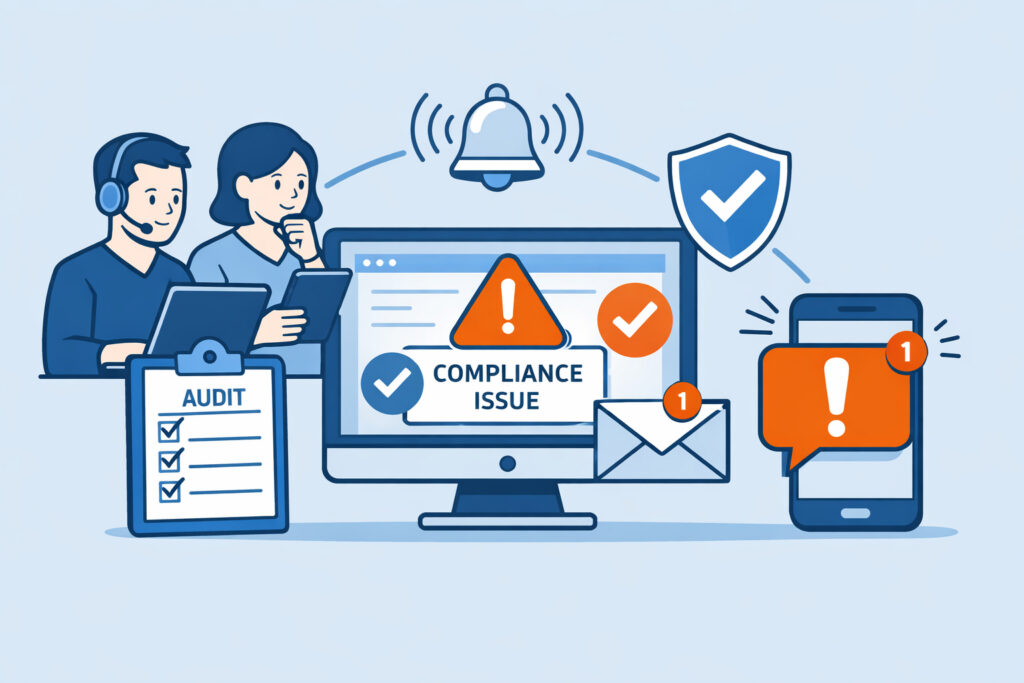
Real-time alerts transform compliance management from a reactive scramble into a controlled, proactive process. If you’re responsible for keeping a website legally compliant – whether that means GDPR privacy policies, cookie consent banners, SSL certificates, or accessibility statements – you already know that problems don’t wait for your next scheduled audit. They happen at 2 AM on a Saturday, during a routine CMS update, or the moment a developer pushes a new template to production.
This article explains why real-time compliance alerts matter, how they work in practice, and what you need to set up a monitoring system that catches issues before regulators or customers do.
Why Scheduled Audits Leave You Exposed
Most businesses still rely on periodic compliance checks – maybe quarterly, maybe monthly if they’re diligent. The problem is obvious once you think about it: your website isn’t static. Content changes, plugins update, certificates renew (or don’t), and third-party scripts load differently depending on the day.
I’ve seen a situation where a WordPress theme update silently removed the footer link to a company’s privacy policy. The site owner didn’t notice for three weeks – not until a customer complaint landed in their inbox. By then, the site had served tens of thousands of pageviews without a functioning privacy policy link. That’s not a hypothetical edge case. It’s a Tuesday.
A manual compliance checking approach might catch this eventually, but “eventually” is the enemy of compliance. Regulators don’t care that you found the problem – they care how long it existed.
What Real-Time Compliance Alerts Actually Monitor
Real-time alerts aren’t just uptime pings. A proper compliance monitoring system watches multiple layers simultaneously:
Legal document availability. Your privacy policy, terms of service, and cookie policy pages need to be accessible 24/7. If any of these return a 404, redirect loop, or blank page, you need to know within minutes – not days.
Cookie consent functionality. This is where things get tricky. A cookie banner can look perfectly fine visually while being technically broken – firing tracking scripts before consent is given, or failing to register opt-out choices. Surface-level checks miss this entirely.
SSL certificate status. An expired SSL certificate doesn’t just trigger browser warnings. In many regulatory frameworks, it represents a failure to maintain adequate data protection measures. Real-time monitoring catches expiration windows before they close.
Security header integrity. Headers like Content-Security-Policy, X-Frame-Options, and Strict-Transport-Security can disappear after server configuration changes. Without monitoring, you won’t know until a security header weakness creates a legal vulnerability.
Accessibility statement presence. Increasingly required by law in the EU and other jurisdictions, accessibility statements need to be findable and current. A missing or outdated statement is a compliance gap.
The Myth of “We’ll Catch It in the Next Audit”
Here’s a misconception that costs businesses real money: the belief that if something breaks, the next scheduled audit will catch it before any harm is done.
The math doesn’t support this. If you audit monthly, the average time a compliance issue goes undetected is 15 days. For quarterly audits, it’s 45 days. During that window, every visitor interaction with your non-compliant site is a potential liability. Under GDPR, supervisory authorities have explicitly noted that the duration of a violation is a factor in determining penalty severity.
Real-time alerts shrink that detection window from weeks to minutes. The difference between a 15-day gap and a 5-minute gap isn’t incremental – it’s transformational for your risk profile.
Setting Up Effective Compliance Alerts
Not all alerting systems are equally useful. Here’s what separates a practical setup from noise:
Prioritize by severity. A missing privacy policy is more urgent than a suboptimal security header value. Your alert system should distinguish between critical failures (legal documents down, SSL expired) and warnings (header misconfiguration, slow-loading consent banner).
Define escalation paths. The person who needs to know about a broken cookie consent banner at 3 AM might not be the same person who handles accessibility issues. Route alerts to the right people based on the type of compliance failure.
Set meaningful thresholds. You don’t want an alert every time a page takes an extra 200ms to load. But you absolutely want one if a legal page returns anything other than a 200 status code, or if a consent mechanism fails to block scripts pre-consent.
Require confirmation of resolution. An alert that fires once and disappears teaches people to ignore alerts. Good systems track whether the issue was actually resolved and re-alert if it recurs.
Keep a compliance log. Every alert, every detection time, every resolution time – logged. This audit trail is gold if you ever need to demonstrate to a regulator that you take proactive compliance monitoring seriously.
What Proactive Compliance Looks Like in Practice
Consider a mid-sized e-commerce business running 12 regional storefronts. Each site has its own privacy policy, cookie consent implementation, and SSL certificate. A developer pushes a template change that accidentally removes the cookie consent script from three regional sites.
With no real-time monitoring, this goes unnoticed until the next manual check – potentially weeks later. With real-time alerts, the compliance team gets notified within minutes. The fix is deployed within the hour. The total exposure window is under 60 minutes instead of under 60 days.
That’s the difference between a near-miss and a regulatory investigation.
FAQ
How quickly should a real-time compliance alert notify me of an issue?
A good monitoring system should detect and alert within 1–5 minutes of a compliance failure occurring. Anything longer than 15 minutes isn’t truly “real-time” – it’s just frequent polling dressed up with a better label. The faster the detection, the smaller your liability window.
Can real-time alerts replace compliance audits entirely?
No – and they shouldn’t. Real-time alerts handle the continuous monitoring side: detecting when something breaks or changes. But you still need periodic deeper audits to evaluate whether your policies themselves are adequate, whether new regulations apply to you, and whether your monitoring coverage has gaps. Think of alerts as your smoke detector and audits as your fire inspection.
What’s the most common compliance issue that real-time alerts catch?
In my experience, it’s legal document availability failures – privacy policies and terms of service pages that go down or become unreachable after site updates. It’s mundane, it’s preventable, and it happens far more often than most people expect. Cookie consent technical failures are a close second, especially after CMS or plugin updates change how scripts load.
Making the Shift
Moving from reactive to proactive compliance management isn’t about buying more tools – it’s about changing when you find out about problems. Every hour a compliance issue exists undetected is an hour of accumulated risk. Real-time alerts don’t eliminate compliance failures, but they ensure that when something breaks, you’re the first to know – not your customers, and certainly not a regulator. Start with your highest-risk areas: legal document availability and cookie consent functionality. Build from there, and you’ll find that compliance stops feeling like a fire drill and starts feeling like a managed process.