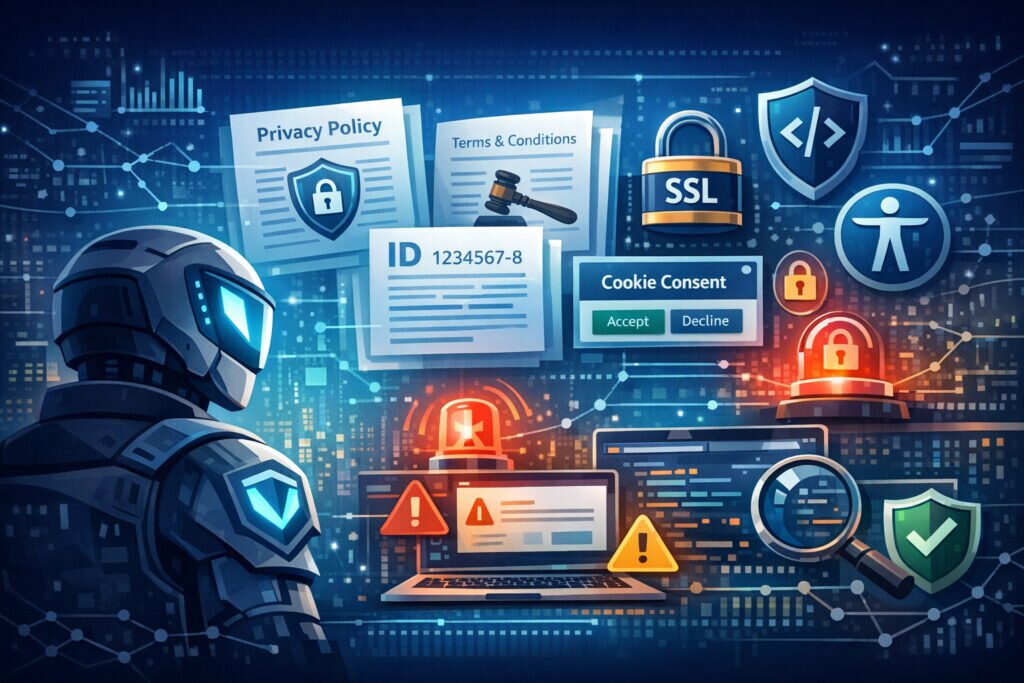
If your website’s privacy policy, terms of service, or cookie notice went offline right now, how long would it take you to notice? For most businesses, the honest answer is hours — sometimes days. Understanding why legal documents need 24/7 availability monitoring is critical because every minute those pages are unreachable, your business operates in a regulatory grey zone that can trigger fines, erode customer trust, and invalidate the very agreements you depend on.
This article breaks down why always-on monitoring of your legal documents isn’t paranoia — it’s a basic operational requirement in 2026.
The Problem Most Businesses Don’t See Coming
Here’s a scenario compliance officers know too well. A routine CMS update pushes a new theme version live. Everything looks fine on the homepage. But the privacy policy page now returns a 404 because someone renamed the slug during a URL restructuring months ago and the redirect silently broke.
Nobody checks the privacy policy page daily. Why would they? It was fine yesterday. Meanwhile, your cookie consent banner still links to it, your signup forms reference it, and GDPR requires it to be accessible at the point of data collection. For the next 72 hours — until a customer complaint finally surfaces — your site is technically non-compliant.
This isn’t hypothetical. It happens constantly, especially on sites that deploy updates frequently or run multiple plugins that touch page routing.
What Regulators Actually Expect
GDPR, the ePrivacy Directive, CCPA, and most modern privacy frameworks share one common thread: legal documents must be accessible at the time the user interacts with your service. Not “usually accessible.” Not “accessible when we last checked.” Accessible right now, every time.
Regulators don’t care that the outage was caused by a plugin conflict or a CDN glitch. If a user couldn’t reach your privacy policy while submitting personal data, the consent mechanism is arguably broken. And broken consent is the kind of thing that turns a routine audit into an enforcement action.
The expectation is continuous availability — and the only way to prove that is continuous monitoring.
Why Manual Checks Always Fall Short
Some teams add “check legal pages” to a weekly task list. Others rely on quarterly audits. Both approaches share the same fatal flaw: they only catch problems that exist at the exact moment someone looks.
A privacy policy page that goes down at 11 PM on a Friday and comes back after a server restart on Saturday morning? A manual check on Monday will never catch it. But your analytics might show hundreds of visitors during that window — visitors whose consent flow was compromised.
Myth: “If the page loads for me, it’s fine.” Not necessarily. Pages can return a 200 status code while serving completely blank content due to a PHP error. They can load for authenticated admins but throw errors for logged-out visitors. They can be accessible from one geographic region but blocked in another due to CDN misconfigurations. Manual spot-checks can’t account for any of this. If you’re still relying on periodic audits, you’re likely operating with gaps you’ve never seen.
What 24/7 Monitoring Actually Looks Like
Effective legal document monitoring goes well beyond pinging a URL once an hour. Here’s what a proper setup covers:
HTTP status verification. Confirming the page returns a valid 200 response — not a redirect chain, not a soft 404, not a server error masked by a custom error page.
Content integrity checks. Verifying the page actually contains your legal text. A page that loads but shows “Coming soon” or a theme placeholder isn’t compliant — it’s a liability.
Response time tracking. A privacy policy page that takes 15 seconds to load is functionally unavailable for most users. Monitoring should flag performance degradation before it becomes an outage.
Alerting with context. When something breaks, you need to know what changed — not just that a page is down. Was it a DNS issue? A plugin conflict? A deleted page? The faster you identify the cause, the faster you fix it. ComplianceVigil handles exactly this: detecting availability and content issues across your legal documents and reporting them before your customers or regulators notice.
The Real Cost of Legal Page Downtime
Let’s put some numbers on this. Under GDPR, fines for consent violations can reach €20 million or 4% of global annual turnover. But even without a formal fine, the costs stack up quickly.
A terms of service page that’s unreachable during a purchase can weaken your legal position if a customer later disputes the transaction. Availability of your ToS isn’t just good practice — it’s a legal requirement that underpins every transaction on your site.
Then there’s the reputational cost. Privacy-conscious customers — and there are more of them every year — will notice a broken privacy policy link. Some will leave. Others will post about it. None of this shows up in a quarterly compliance audit.
Getting Started: A Practical Approach
You don’t need to overhaul your entire compliance infrastructure overnight. Start with these steps:
1. Inventory your legal pages. List every URL that serves a legal function: privacy policy, terms of service, cookie policy, accessibility statement, return policy, imprint page. Don’t forget translated versions if you operate in multiple languages.
2. Set up automated monitoring. Each page needs status checks, content verification, and alerting. Check intervals of 5–15 minutes are a reasonable baseline for most businesses.
3. Define escalation paths. Who gets notified first? What’s the expected response time? A 3 AM alert about a missing privacy policy needs a clear owner, not an unmonitored inbox.
4. Review historical data regularly. Monitoring isn’t just about catching outages — it’s about spotting patterns. If your privacy policy page goes down every time WordPress auto-updates, that’s a deployment process issue worth fixing at the root. Understanding how fast you can detect and respond to outages directly determines your compliance risk exposure.
FAQ
How often should legal documents be monitored?
At minimum, every 15 minutes. High-traffic sites or those in heavily regulated industries should consider 5-minute intervals. The goal is to minimize the window between an outage occurring and your team being notified — anything longer than 30 minutes creates real risk.
Does a privacy policy outage automatically mean a GDPR violation?
Not automatically, but it creates a significant vulnerability. If personal data was collected while the privacy policy was inaccessible, the legal basis for that processing is weakened. Regulators look at whether you had reasonable measures in place to prevent and detect such gaps — which is exactly what automated monitoring provides.
Can’t my existing uptime monitoring tool handle this?
Standard uptime monitors check whether a server responds. They typically don’t verify that the page contains the correct legal content, that consent links resolve properly, or that the document is accessible to all visitor types. Legal document monitoring requires content-level verification, not just status code checks.
The Bottom Line
Legal documents are the foundation of your website’s regulatory compliance. Treating their availability as an afterthought — something you check manually once in a while — is a risk that’s no longer justifiable. Automated 24/7 monitoring closes the gap between “we think it’s fine” and “we know it’s fine, and we have the data to prove it.” In a regulatory landscape that demands accountability, that proof is what separates compliant businesses from vulnerable ones.